Showing posts with label COMPARATIVE ANATOMY. Show all posts

SHARK EYES -STRUCTURE

SHARK EYE (SCOLIODON EYE) –ANATOMY

Shark two eyes are present on the head. They are located in the orbits and are laterally directedshark-eye

The eye is large in size and elliptical body. It is a hollow structure. It is covered by three coats.

1) The fibrous outer coat is thick. It protects the eyeball and maintains its form. It has large posterior scierotic and anterior transparent cornea The sclerotic coat is cartilagenous.lt is hidden in the orbit. A small portion is visible externally, called the white of the eye. The cornea is composed of connective tissue. It is covered by a transparent epithelium called conjunctiva. The cornea permits the light to pass into the eye.

2)The middle coat has three distinct regions.

1) The choroidis composed of a soft connective tissue with pigment cells and blood vessels

2) The choroid is adjacent to the retina and contain light reflecting crystals called tapetum lucidium.

3) At the junction of the sclerotic and the cornea the middle coat, abruptly bends into the cavity of the eye as "iris", it has slit called pupil. Behind the periphery of the iris, the middle coat is thicker, and less pigmented and is called the ciliary body. It has no muscles and plays no role in accommodation.

shark-eyes

3)The retina is very delicate and lines the whole of the middle coat, it has three regions.

a) optic part is in contact with the choroid. It is sensitive to light,

b) The ciliary and

c) Iridial parts are non sensory parts.

The point of the retina from where the optic nerve leaves the eye is called the blind spot. This region has no receptors. It is not sensitive the light. The retina contains rods. The cones are absent. The fish is colour blind. Its eye is adapted to "dim light" vision.

Shark-eye1

A solid transparent crystalline lens, lies just behind the pupil. It is held in place by a gelatinous suspensory ligament. It extends from the lens capsule to the ciliary processes. The lens divides the cavity of the eye into two chambers. The anterior smaller aqueous chamber and the posterior larger vitreous chamber. The aqueous chamber is partly divided into anterior and posterior parts by iris. It has aqueous humour. The vitreous chamber is filled with the vitreous humour. The humours keep the eye inflated and aid in focusing Sight rays on the retina  of shark.

The eye is protected by three lids. The upper end lower lids are folds of skin are immovable. The third eyelid, the nictineting membrane is well developed. It covers the eye fully. It is a growth of the anterior region of the lower eyelid. Lacrimal gland is absent.

know about cranial nerves of sharks

CRANIAL NERVES OF SCOLIODON (SHARK)

SHARK FISH (SCOLIODON) CRANIAL NERVES ORIGIN AND PHYSIOLOGICAL FUNCTION

Ten pairs of cranial nerves arise from the brain at different loca­tions to supply the anterior region of the body. In addition to them a pair of terminal or pre olfactory nerves (zero nerves) arises from the ventral surface of the cerebrum.

The ten pairs of cranial nerves are furnished below for detail study.

cranial-nerves-scoliodon


1. BRANCHIALIS X
3. LATERALIS X
4. BUCCALIS VII
5. CEREBELLUM
6. OPTIC III
7. OPHTHALMICUS SUPERFICIALIS V& VII
8.OLFACTORY LOBE
9.BUCCALIS VII
10. PALATINUS VII
11.MAXILLARIS INFERIOR V
12.MANDIBULARS V
13. MANDIBULARS EXTERNUS VIII
14. HYOMANDIBULARIS VII
15. PHARYNGEAL
16. OPHTHALMICUS PROFUNDUS V
17. POST TREMATIC PRETREMATIC IX IX 
18. MANDIBULARS INTERNUS VII 


Name of the nerve

Origin


Branches


Distribution


Physiological Nature

I. OLFACTORY Olfactory lobe.       Olfactory epithelium of the nasal cavity.   Sensory
               
2. OPTIC Optic lobe.       Retina of eye.   Sensory
               
3. OCULOMOTOR Ventrolateral side ofthe midbrain.       Anterior rectus, superior rectus, inferior rectus and inferior oblique muscles of the eye. Superior oblique muscle of the eye   Motor Motor
               
4 TROCHLEAR Dorsolateral aspect of the midbrain between the optic lobes and cerebrum.       Olfactory capsule and dorsal   Mixed
               
5 TRIGEMINAL Dorsally from the side of medulla oblongata below the corpora restiformes.   (i) Opthalmic profundus (ii) Ophthalmicus superfi-cialis V (iii) Maxillaris V (a) Superior (b) Inferior (iv) Mandibularis   skin of the snout. Skin of the snout. Skin of upper jaw Posterior part of upper lip. Muscles of the lower jaw.   Mixed Motor Mixed
               
6. ABDUCENS Midventrally from the floor of medulla oblongata       Posterior rectus muscle of the eye.   Mixed
7. FACIAL From the side of medulla below the corpora restiformes in the form of a bundle.   (i) Opthalmicus super-ficialisVII (ii) Ramus buccalis (iii) Flyomandibularis (a) Mandibularis exte-rnus (b) Mandibularis inter-nus (c) Hyoidean (iv) Ramus palatinus   Sense organs; the lateral line system of snout. Infra-orbital lateral line canal and associated ampullae. Mandibular canal of lateral-line system. Mucous membrane of the floor of buccal cavity. Muscles of the roof of buccal cavity and pharynx. Roof of the pharyngeal and buccal cavity.   Mixed Mixed Mixed Mixed Mixed Sensory
               
8. AUDITORY From the side of medulla close to the V and Vll cranial nerves.   (i) Vestibular (ii) Saccular   Membranous labyrinth of the internal ear   Sensory
               
9. GLOSSOPHARYN GEAL From the ventro-lateral side of medulla. .   (i) Pre-trematic (ii) Post-trematic   Mucous membrane of the first gill-cleft and the pharynx. The muscles of the pharynx Gills.   Sensory Mixed Mixed
               
10. VAGUS Side of Medulla.   (a) Branchialis (b) Visceralis (c) Lateralis   Viscera. Lateral-line system of the trunk.   Mixed Mixed Mixed

FEMALE REPRODUCTIVE SYSTEM OF BIRD-RABBIT-REPTILE-COMPARISION


FEMALE REPRODUCTIVE SYSTEM OF CALOTES (LIZARD) vs

FEMALE REPRODUCTIVE SYSTEM OF COLUMBA (PEGION )vs

FEMALE REPRODUCTIVE SYSTEM OF RABBIT-MAMMAL)-COMPARITIVE ANATOMY

Reptile -bird-mammal-female reproductive organs similarities and differences in glance in a table

bird-reproductive-system-female


FEMALE REPRODUCTIVE SYSTEM- CALOTES FEMALE REPRODUCTIVE SYSTEM- PEGION FEMALE REPRODUCTIVE SYSTEM- RABBIT
1, On the right and left sides two ovaries are present. 1. Only left ovary is present. A vestige of right ovary may occur. 1. A pair of ovaries are present on the left and right sides. They are small and compact bodies.
2. Ovaries are irregular bodies situated assymetrically and hanging from the dorsal wall of the body cavity by mesovaria. 2. The single left ovary is attached to anterior lobe of the left kidney by mesovarium. 2. The ovaries lie behind the kidneys and attached to dorsal wall of the abdominal cavity by mesovaria.
3. Right ovaiy is a little anterior to the left one. 3. Right ovary is absent. 3. Right and left ovaries are at the same level.
4. Oviducts are paired. 4. Only left oviduct is developed. A vestige of right oviduct is often seen. 4. Oviducts are paired.
5. Oviducts give striated appearance over greater part of their length. 5. Oviduct doesnot give striated appearance. 5: Striated appearance is absent.
6. Oviducts extend well ahead of ovaries and follow straight course. 6. Oviduct starts'just behind the ovary and follow a convoluted course. 6. Oviducts start just outside the ovaries and follow convoluted course.
7. Oviducal funneb are large and have externally directed ostia with the entire margin. 7. Single Left oviducal funnel is very large and membranous. It has fimbricated margins it lies close to the ovary with it; ostium. 7. Oviducal funneb are small and have internally directed ostia with fimbricated margin.
8. Each oviduct dilates to form an oval shell gland along the ventral surface of the kidney uteri are not demarcated. Oviducts are enlarged into small ovisacs. These are two vaginae. Vaginae open into the urodaeum. 8. The oviduct is divided into anterior oviducal funnel, behind it magnum which is thick walled & secretes albumen. Below the Magnum is isthmus which secretes shell membrane and the succeeding part is the uterus. Uterus is thin walled and secretes calcareous shell and albumen. The posterior most part is the thick walled and mus-cular vagina. 8. The oviducal funel leads distaliy :uio a bng, narrow and convoluted tube - Fallopian tube. Its walls are lined with Ciliated epithelium. The posterior most parts of the two oviducts form uteri. These are widened muscular and»/ascular structures. The paired uteri open into median and highly muscular chamber-vagina. Associated with urethra, the vagina forms the urino-genitaf canal or vestibule.
9. Urodaeum opens outside by a transverse cloacal aperture. 9. Urodaeum opens out by a transverse cloa-cal aperture. 9. Urino - genital canal opens outside by a longitudinal aperture - vulva lying infront of the anus. Vulva has 'clitoris.'
10. There are no special glands associated with female reproductive system. 10. Same as in calotes. 10. Cowper's and perineal glands are associated with female reproductive system.
11. Milk glands are absent. 11. Milk Glands are absent. 11. On the ventral surface of trunk region 4 or 5 pairs of milk glands open through their tears.
12. Fertilization is internal oviparous animal. 12. Same as in calotes. Oviparous animal 12. Same as in calotes and columba. Viviparous animal

rabbit-reproductive-system-female

reptile-reproductive-system-female

previous page-male reproductive system of bird-reptile-mammal

MALE REPRODUCTIVE SYSTEM OF BIRD-RABBIT-REPTILE-COMPARISION


MALE REPRODUCTIVE SYSTEM OF LIZARD (CALOTES)

MALE REPRODUCTIVE SYSTEM OF PEGION ((COLUMBA)

MALE REPRODUCTIVE SYSTEM OF MAMMAL ((RABBIT- ORYCTOLAGUS)-COMPARITIVE ANATOMY

The following table and images clearly

shows the similarities and differences between male urino genital system of lizard-bird-mammal.

bird-reproductive-system-male


MALE REPRODUCTIVE SYSTEM OF CALOTES (GARDENLIZARD) MALE REPRODUCTIVE SYSTEM OFCOLUMBA (PIGEON) MALE REPRODUCTIVE SYSTEM OFORYCTOLAGUS (RABBIT)
1. Testes are white ovoid bodies. 1. Testis white ovoid bodies. 1. Testes are pink, ovoid bodies.
2. Testes lie in the abdominal cavity much ahead of kidneys. Inguinal canal is absent. 2. Testes lie in the abdominal cavity under the anterior parts of kidneys. Inguinal canal is absent. 2. Testes are extra abdominal and lie in the scrotal sacs which are the folds of the skin. They are connected with perivisceral cavity by inguinal canals.
3 Right testis is a little ahead of the left one. 3. Left testis is a little bigger than the right one. 3. Right and left testes are symmetrical.
4. Spermatic cord is not formed. 4. Same as in calotes. 4. A spermatic cord extends from each testis to a little behind the kidney of its side.
5. Each testis is attached to the dorsal body wall by a double fold of peritoneum the mesorchium. 5. Each testis is attached to the kidney of its side by mesorchium. 5. Each testis is attached to the wall of scrotal sac by a short, thick, elastic cord 'gubernaculum'.
6. From the inner end of each testis arises a much convoluted tube-epididymis. 6. Epididymis is absent. 6. Epididymis is present.
7. Caput and cauda epididymis are not found 7. Same as in calotes. 7 Caput epididymis and cauda epi-didymes are the extensions of epididymis infront and behind the testis
8. Epididymis is continued behind as long, narrow, coiled and delicate vas deferens. It passes backwards along the ventral surface of the kidney of its side and joins with the ureter to form urino-genital sinus which opens into the cloaca. 8 The vas deferens arises directly from the inner border of the kidney in the form of a narrow convolutec tube. It runs backwards outside the ureter parallel to it and both open dorsally by separate aperture in urodaeum of the cloaca. 8. The vas deferens passes through the inguinal canal and runs forward and enters into the abdominal cavity. So that a loop around the ureter of its side to open into sac-uterus masculinus' which is present in the dorsal wall of the urinary bladder.
9. Seminal vesicles are absent. 9. Posterior end of each vas deferens enlarges to form seminal vesicle. 9. Seminal vesicles are absent.
10. There are no special glands associated with male genital system. 10. Same as in calotes. 10. There are prostate, couper's and perineal glands are associated with the male genital system.
11. In male a pair of eversible copulatory organs 'hemipenes' lie under the skin behind cloacai aperture 11. Copulatory organs are absent. 11. The copulatory organ in male is in the form of a thick muscular 'Penis'. It is covered by skin loose fold prepuce or foreskin penis is made up of a spongy tissue containing bbod vessels and it is erectile.

rabbit-reproductive-system-male

reproductive-system-reptile-male

previous topic is frog reproductive system-fish reproductive system-comparison

FROG-REPRODUCTIVE SYSTEM-FISH- REPRODUCTIVE SYSTEM-COMPARISION

MALE URINOGENITAL SYSTEM OF SHARK FISH (SCOLIODON) AND FROG(RANA)AND FEMALE REPRODUCTIVE SYSTEM IN SHARK AND FROG-COMPARATIVE ANATOMY

Shark is a marine cartilagenous fish, it is also known as scoliodon which is a poikilothermic animal. Frog is an amphibious animal. Both the animals have been included in Anamniota Frog is also poikilothermic animal.
Reproductive system consists of gonads and genital ducts. The gonads are the essential reproductive organs. In male the gonads are the 'testes' or 'spermaries' and 'ovaries' in the female. The gonads are mesoder¬mal in origin and develop from a pair of genital ridges of the embryo. The genital ridges are the folds of coelomic epithelium lying on the medial sides of the embryonic kidneys. When fully formed, the gonads hang from the dorsal body wall of the double folds of peritoneum called as 'Mesorchia' in the case of testes and 'mesovaria' in the case of ovaries. The gonads produce sex cells or gametes. They are known as 'spermatozoa or sperms' in the male and 'ova' in the female. The gonads also secrete some important hormones.
The genital or reproductive ducts are developed for transporting the gametes produced by the gonads. These are known as ‘Vasa deferentia'
in the male and 'oviducts' in the female.
There is an intimate relation present between the ureters and genital ducts particularly in the male. Hence the excretory and reproductive systems are collectively reffered as  urinogenital system.frog-reproductive-system-male

fish-reproductive-system-male-shark

MALE REPRODUCTIVE SYSTEM OF SHARK FISH(SCOLIODON)- MALE REPRODUCTIVE SYSTEM FROG(RANA)-SIMLARITIES AND DIFFERNCES

SHARK-MALE - URENOGENITAL SYSTEM FROG -MALE - URENOGENITAL SYSTEM
L. Testes are very long and ribbon like. 1. Testes are small and rod-like.
2. Testes are attached to the kidneys anteriorly. 2. Testes are attached to the kidneys above the middle region with mesorchium.
3. Testes are connected with the rectal gland by epigonal organs. 3. The epigonal organs are absent.
4. Vasa efferentia leave the testis at its anterior end. 4. Vasa efferentia leave the testis alone its inner border.
5. These open into the wolffian duct. 5. These enter the kidney and open into .the Bidder's canal which drains into the wolffian duct.
6. Wolffian duct is differentiated into an anterior narrow closely convoluted epididymis and the posterior wide less convoluted vesiculus seminalis. 6. Wolffian duct is notdefferentiatedint< the parts except having a small seminal vesicle near its beginning.
7. Wolffian ducts act only as genital ducts. 7. Wolffian ducts act as both urinary and genital duct. Hence they are known as urinogenital ducts.
8. A pair of club-shaped sperm sac open into the urinogenital sinus 8. Sperm sacs are absent
9. The copulatory apparatus comprising siphons and claspers. 9. Copulatory apparatus is absent.
10. Sperms are released into the genita iuct of female, hence fertilization is internal. 10. Sperms are released over the eggs tithe fresh water, hence fertilization is external. Sperms are released as milt'
11. There are no fat bodies attachec to the testes. 11. There is a large branched fai-bodv attached to the anterior end of ead testis.
12. There is a single urino-genital papilla. 12. Urino-genital papillae are paired.


FEMALE REPRODUCTIVE SYSTEM OF  FISH(SCOLIODON-SHARK)- VS  -FEMALE REPRODUCTIVE SYSTEM FROG(RANA)

frog-reproductive-system-female

shark-fish-reprocuctive-system-female

SHARK -FEMALE - REPRODUCTIVE SYSTEM FROG -FEMALE - REPRODUCTIVE SYSTEM
1. Ovaries are small, tabulated bodies located just behind the base of the liver. 1. Ovaries are large, hollow, lobed sacs laying on the ventral surface of the kidneys.
2. Ovaries are connected with rectal glands by long epigonal organs. 2. Epigonal organs are absent.
3. Oviducts (Mullerian ducts) are long but not convoluted. 3. Oviducts (Mullerian ducts) are very long and greatly convoluted.
4. Oviducts converge and unite in front of the ovaries leaving a slit 'ostium tubae! The oviducal funnels are on either side of ostium tubae. 4. Oviducts converge infront of the ovaries but do not unite. Each oviduct has its own ostium at the lip of oviducal funnel.
5. The oviducts possess a small enlargement behind ovaries This enlargement is called shell gland. 5. There is no shell gland
6. The oviducts are expanded to form large uteri in the region of renal part of kidneys 6. The oviducts are expanded to form small ovisacs behind the kidneys.
7. The oviducts join to form a median sac-'vagina' which opens into the cloaca. 7. The oviducts independently open into the cloaca. The vagina is absent.
8. There are no fat bodies. 8, There is a large fat body attached to the anterior end of each ovary.
9 Since the fertilization in internal, there is no question of releasing the egg out side the body 9. The mass of eggs is called "spawn* which is released outside the body Fertilization is external.

VENOUS SYSTEM OF REPTILE- BIRD –MAMMAL COMPARISION

VENOUS SYSTEM OF CALOTES (LIZARD-TERRESTRIAL REPTILE) AND COMPARE WITH THAT OF VENOUS SYSTEM OF PIGEON (BIRD) AND VENOUS SYSTEM OF RABBIT (MAMMAL).

Calotes is a cold blooded (poikilothermic) and terrestrial garden lizard. Pigeon is a ward blooded bird adapted for aerial mode of life. Rabbit is warm blooded and a herbivorous mammal which is also known as Oryctolagus. The circulation of blood in vertebrates is of closed type(circulation occurs is blood vessels. The blood vessels which collect blood from different parts of the body are called as veins. The walls of veins are thick and possess valves.Thier lumen is wide. They collect deoxygenated blood from different parts of the body and carry to the heart. The veins are formed by means of capillaries in the respective tissues or organs. The deoxygenated blood is received by the sinus venosus or the right auricle. The portal veins are having capillaries at their both ends. The pulmonary veins possess oxygenated blood.

lizard-venous-system-reptile

lizard(Calotes) - Venous System
1) Sinus Venosus
2) Post-caval
3) Liver
4) Postcaval
5) Gonad
6) Right efferent renal vein
7) Trachea
8) External jugular vein
9) Internal jugular vein
10) Pulmonary vein
11) Ventricle
12) Hepatic vein
13) Stomach
14) Hepatic portal vein
15) Anterior a bdominal vein
16) Gonad
17) Left efferent renal vein •
18) Renal portal vein
19) Femoral vein
20) PeMc vein
21) Caudal vein.

bird-venous-system


VENOUS SYSTEM OF CALOTES (GARDEN LIZARD) VENOUS SYSTEM OF COLUMBA (PIGEON) VENOUS SYSTEM OF ORYCTOLAGUS (RABBIT)

1. The venous system consists of common pulmonary vein, two precaval and one post caval veins. These collect blood from the various parts of the body.

1. The venous system con­sists of three large veins-teeo precavak and one post caval along with four large pulmonary veins.

I. The venous system con­sists of four distinct divisions. i) System of venae carae ii) Hepatic portal system iii) Pulmonary system iv) Coronary system

2. The two precaval veins collect blood from the anterior part of the body. Each precaval is formed by the union of the internal and external jugular veins from head and the sub clavian vein from the arm. Transverse jugular vein is absent. Azygous vein is also absent.

2. The two precaval veins collect blood from the anterior part of the body. Each precaval vein is formed by the union of Jugular (head), brachial (arm) and pectoral (Pectoral muscfes) veins. Transverse jugular vessel is present in between the jugular veins. Azygous vein is absent

2. The two precaval veins collect blood from the anterior part of the body. Each precaval vein is formed by the union of the external jugular vein (head) and subclavian vein (fore limb). The right precaval vein receives the azygous (unpaired) and intercostal veins (intercostal muscles and dorsal wall of theory). Left azygous vein is absent.

3. The post canal vein joins the posterior angle of the sinus venous. It forms by the union right and left efferent renal veins and brings blood from the posterior side.

3. The post caval vein is formed by the union of two large itac veins a tittle behind the liver.

3. The post caval vein is a large median vein. It stands at the cauda region (icaudal vein] and runs forward and receives blood in its course. The veins which join the posl caval vein are pairec ilio himbars, iliacs gonadial renal, anc hepatic.

4. The renal portal system collects blood from the posterior side of the body. Caudal vein bifurcates into two pelvic veins which . unite in front and form into the median anterior abdominal vein enters into the liver. Each pelvic vein joined by femoral, sciatic veins of that side. From the pelvic arise the renal portal veins which branch into capillaries in the substance of the kidneys coccygeo-mesenteric vein is absent.

4. Renal portal system is not well developed in pigeon caudal vein bifurcates into right and left renal portal veins (Hypo gastric veins) each of which enters the kidney. The hypogastric vein receives the Internal iliac vein abng with femoral & sciatic veins. At the bifurcation of the caudal vein into the two renal portal veins arise a median 'coccygeome-senteric vein'. It is characteristic of birds. The coccygeo- mesenteric vein joins the hepatic portal vein.

4. Renal portal system is completely absent in Rabbit.

5. The Hepatic portal vein collects blood from the alimentary canal and enters the liver and breaks upto capillaries.

5. The Hepatic portal vein collects bbod from the alimentary canal and emptied into the liver. From the Ever the blood is carried by the post caval vein through hepatic veins.

5. Same as in pigeon.

6. Epi gastric vein is absent.

6. Epi gastric vein returns the blood from the mesenteries and joins the hepatic veins. This vein corresponds to the abdominal vein of the frog.

6. Epi gastric vein is absent.

7. The right and left pulmonary veins bring pure blood from the right and left lungs and united into a common branch. Common pulmonary vein opens into the left auricle.

7. Four large pulmonary veins return blood from the posterior part of the left auricle

7. A pair of pulmonary veins bring oxygenated blood from the lungs They unite by a common arch and open into the dorsal wall of the left auricle

8. The right auricle receives deoxygenated blood through sinus venosus and left auricle possess oxygenated blood. In the partially divided ventricle the blood mixes to some extent.

8. The right side of the heart (right auricle & ventricle) receives de-oxygenated blood and left side folded with (left auricle & ventricle) oxygenated blood.

8. Same as in pigeon. Coronary veins collect deoxygenated blood from the wall of the heart. The coronary sinus opens into the right auricle through an aperture guarded by the Valve of The besius'. The opening is called as the 'formina of the The besius'.

venous-system-rabbit-mammal

comparative anatomy of  venous system of frog and venous system of fish

VENOUS SYSTEM FROG -VENOUS SYSTEM OF FISH-COMPARATIVE ANATOMY

VENOUS SYSTEM OF RANA(FROG) AND VENOUS SYSTEM OF SCOLIODON(SHARK FISH) –COMPARISION

Scoliodon commonly called as shark fish is a poikilothermic(cold blooded) animal. It is cartilaginous fish. Rana (frog) is also poikilothermic and amphibious animal. The circulation of blood in vertebrates is of closed type. The blood vessels which collect blood from various parts of the body are known as veins. The walls of the veins are thin and possess valves. Their lumen is wide. They collect deoxygenated blood from different parts of the body and carry to the heart. The veins are formed by means of capillaries in the respective tissues or organs. The deoxygenated blood first enter into the sinus venosus which is the part of the heart. The portal veins are having capillaries at their both ends. The pulmonary veins possess oxygenated blood.

frog-venous-system                                     FROG -VENOUS SYSTEM

1) External Jugular Vein.
2) Innominate Vein
3) Subclavian Vein
4) Pulmonary Vein
5) Hepatic Vein
6) Renal Vein
7) Gonadial.Vein
8) Dorso-Lumbarvein
9) Renal Portal Vein
10) Femororenal Vein
11) Pelvic. Vein
12) Femoral Vein
13) Sciatic Vein
14) Lingual Vein
15) Mandibular Vein
16) Internal Jugular Vein
17) Sub Scapular Vein
18) Brachial Vein
19) Musculo Cutaneous Vein
20) Cardiac Vein
21) Hepatic Portalvein
22) Anterior Abdominal Vein


FISH (SHARK)-VENOUS SYSTEM

(FROG (RANA) -VENOUS SYSTEM

1.The venous system comprises a system of large thin walled sinuses which collect blood from the different body organs 1 The venous system comprises of thin walled tubular veins.
2.It consists of the following systems i) Anterior cardinal system ii) Posterior cardinal system iii) Hepatic porta! system iv) Ventral veins viCutanecious system 2 It is divided into i) Anterior system of veins ii) Posterior system of veins iii) Portal systems.
3.The anterior cardinal system and the interior jugular sinuses collect blood from the head region through a number of sinuses. 3 The blood from the head region is collected by a pair of precoval veins. Each precaval vein is formed by External jugular, innominate and subclavian veins.
4The blood from gills is collected by five pairs of dorsal nutrient sinuses and five pairs of ventral nutrient sinuses. 4.The blood from the lungs is collected by a pair of pulmonary veins.
5The nutrient sinuses carry deoxygenated blood. 5.The pulmonary veins carry oxygenated blood.
6.The nutrient sinuses empty into anterior cardinal and interior jugular sinuses which inturn open into the ductus cuvieri. Thus the blood finally carried to the sinus venosus. 6.The pulmonary veins open into the left auricle.
7 From the posterior part of the body the blood is collected by i) a pair of posterior cardinal sinuses ii) a pair of lateral abdominal veins iii) a pair of brachial veins. 7.The blood from the posterior part of the body is collected by i) renal portal system and ii) Post caval vein.
8.The renal portal system includes the caudal vein and the renal postal veins & Iliac veins. The blood from the pelvic fins is not carried to the kidneys. 8.The renal portal system consists of veins hind limbs i.e. femoral, sciatic and renal portal veins. The caudal vein is absent.
9.It is absent. 9.A part of the blood from the hind-body is transported to the liyer by an anterior abdominal vein.
10.The blood from the kidneys is collected by renal veins which open into posterior cardinals, opening into the cuvierian sinus. 10.The blood from kidneys is collected by four pairs of renal veins which open into the post caval vein.
11.The brachial veins join the lateral abdominals to form sub clavian veins which open into the ductus cuvieri. 11.The brachial veins open into the precaval veins particularly into the subclavian veins.
12.Three pairs cutaneous veins collect blood from the muscles of skin and open into the cardinal sinuses, lateral abdominals and brachial veins. 12.The cutaneous veins are only one pair which join with muscular & brachial and finally open into the subclavian veins.
13.The venus blood does not enter the sinus venosus directly. But it is collected first by the cuvierian sinus present transversely. 13.The blood collected by the two precavals and one post caval veins directly enters into the sinus venosus.
14.The blood from the parts of the alimentary canal is collected by the Hepatic portal vein and empties into the liver and from there it is transported by Hepatic sinuses into the sinus venosus. 14.The Hepatic portal vein collects blood from the different parts of the alimentary canal and empties into the liver. From the blood is transported into the sinus venosus through the hepatic veins and post caval vein.


fish-venous-system-shark

also read ditaitl discussion about arterial system of fish and arterial system of frog

ARTERIAL SYSTEM-FISH (SCOLIODON), ARTERIAL SYSTEM-FROG (RANA)-CAMPARISION

ARTERIAL SYSTEM-IN PISCES AND AMPHIBIANS- SIMILARITIES AND DIFFERENCES

Scoliodon( Shark)is a poikilothermic animal. It is a cartilaginous fish .Frog ( Rana) is a cold blooded and amphibious animal. The circulation of blood is carried by closed vessels. The vessels which supply blood to the various organs of the body are known as arteries as the net work of arteries form the Arterial system. The walls of arteries are thick and lumen is narrow. The blood pressure is high in the arteries. Arteries do not possess valves. The arteries end in capillaries. Arteries deeply seated in the body. Mostly arteries contain oxygenated blood. A few arteries also carry deoxygenated blood to the respiratory organs (either gills or lungs) for purification. shark-fish-arterial-system


Scoliodon (fish)

FROG-RANA

1 The arterial system consists of a ventral aorta, afferent and efferent branchials, dorsal aorta, and its branches and hypobranchials. 1.The arterial system consists of a truncus arteriosus, three pairs of aortic arches and the dorsal aorta & its branches.
2 Five pairs afferent branchial arteries are present. 2 Absent.
3 Efferent branchial system is associated with gill-slits along with the respective arteries. 3 Absent.
4 The arteries to the head are given off from the first pair of epibranchials and by the branches of dorsal aorta carotid labyrinth is absent. 4.The head is supplied blood by the branches. Carotid arteries arising from the truncus arteriosus. Carotid labyrinth is present,
5 Parietal arteries are present. 5. Parietal arteries are absent.
6 Hypobranchial plexus is present. 6 It is absent.
7 Dorsal aorta is formed by the union of epibranchial arteries of both the right and left sides. 7 The second branches of turncus, the systemic arches of the left and right sides unite to form the dorsal aorta.
8 Subclavian arteries arise from the dorsal aorta. 8 Sub clavian artery arises from each systemic arch.
9 Absent. 9 Occipito-vertebral artery arises from the systemic arch of each side.
10 Coeliaco-mesenteric artery aris­es from behind the union of the four pairs of epibranchials. 10.Coeliaco-mesenteric artery arises from the junction of the two system¬ic arches.
11 Just below the Coeliaco-mesen­teric artery, lienogastric artery arises. 11.Lie no gastric artery is absent..
12 The parietal artery gives off four pairs renal arteries. 12.Four pairs of renal arteries arise directly from the dorsal aorta.
13 Gonadial (Spermatic or ovari­an) artery arises from the lieno ­gastric artery. 13.Gonadial arteries arise directly from the first pair of renal arteries.
14 Dorsal aorta terminates into caudal artery. 14.C-iudal artery is absent
15 Pulmo cutaneous arch is absent. 15.The third branch of truncus is the pulmo-cutaneous arch which is divided into pulmonary and cutanecious arteries.

  Copy of ARTERIAL-SYSTEM-FROG


1. Carotid trunk

2. Systemic trunk

3. Pulmocutaneous

4. Pulmonary artery

5. Coehaco-mesentenc artery

6. Dorsal aorta

7. Renal artery

8. Gonadial artery

9. Vesicuo epigastric artery

10. Femoral artery

11. Sciatic artery

12. External carotid artery

13. Palatine artery

14. Internal carotid artery

15. Carotid labyrinth

16. Oesophageal artery

17. Cutaneous artery

18. Occipito vertebral artery

19. Sub clavian artery

20. Heart

21. Lung

22. Coeliac artery

23. Anterior mesenteric artery

24. Splenic artery

25. Posteior mesenteric artery

26. Iliac artery.

The heart of fish possess venous blood and blood passes through the heart only once in a complete circuit. But in frog the heart receives both oxygenated and venous blood and the circulation is bi circuit.

The fish is an aquatic animal and possesses five pairs of gills. The blood is supplied by pairs of afferent bronchial arteries and is collected by nine pairs of efferent bronchial arteries. In frog however, the respiratory organs are a pair of lungs (skin & buccal cavity also help in respiration) which are supplied by a pair of pulmonary arteries.

PELVIC GIRDLE OF BIRD-REPTILE-MAMMALE-COMPARITIVE ANATOMY


pelvic girdles lizard(calotes) pegion(columba) and rabbit(oryctolagus)

The pelvic girdle is directly attached to the vertebral column in the sacral region. The pelvic girdle consists of two similar halves which are known as ossa innominata. Each os innominatum is. formed by three bones. The dorsal bone is known as ilium, antero-Ventral bone is named as pubis and the ventral bone is called ischium. The pelvic girdle has a depression (concavity) at the junction of the three bones. It is known as acetabulum, into which the head of femur of the hind limb articulates.

previous topic is comparison of pelvic girdle of fish and frog

lizard-pelvic-girdle

bird-pelvic-girdle rabbit-pelvic-girdle  

The same bones are present in all the pelvic girdles of the different vertebrates but have undergone modification.


Calotes (Garden lizard) Columba (Pigeon) Oryctolagus (Rabbit)
1.. Pelvic girdle is stout and solid. Ifts well suited for walking habits. 1. Pelvic girdle is large and pneumatic. It is well suited for bipedal locomotion. 1. Pelvic girdle is stout and associates with the vertebral column. It is adopted for swift running.
2.Each os innominatum is formed by the ilium, ischium and pubis. 2. Same as in calotes. 2. Each os innominatum is formed by ilium, ischium, pubis and cotyloid cartilage bones.
3. The bones are structurally united. 3. The bones are compactly fused. 3. Same as in columba.
4. Ilium is strong, rod shaped and is directed upwards. 4. Ilium is long, thin and plate-like bone. It is differentiated into preacetabular and postacetabular regions. 4. Ilium is large and broad. The antero-dorsal edge is raised to form iliac crest.
5. Ilium articulates with two sacral vertebrae,. 5. Ilium articulates with synsacrum. 5. Anteriorly ilium has articular surface for the sacral vertebrae
6. Ischium is flat, slightly curved and axe-shaped. It is directed downwards and backwards. 6. Ischium a flat bone fused with the post acetabulariiium. They are separated by ilio-ischial foramen. 6. Ischium is broad and slightly curved bone lying behind ilium. It is posterodorsal in position.
7. Ilio-ischial foramen is present. 7. llio-ischial foramen is large. 7. Ilio-ischial foramen is absent.
8. Ischial tuberosity is absent. 8. It is absent is pigeon. 8. Ischium bears an ischial tuberosity.
9. Ischial symphysis is present. 9. It is absent. 9. Ischial symphysis is present.
10-. Hypoischium is present between the ends of the two ischia 10. Absent. 10. Absent.
11. On the ventral side posteriorly the pubis is formed like a flat elongated and slight ly curved bone, pubis 11. Pubis is long, slender, curved bone. 11 lies ventral and parallel with ischial;;* Pubis 11. Pubis is flat curved bone directed ventrally pubis symphysis is present. Epipubis is absent.

also view comparison of pectoral girdle of bird-reptile-mammal

PECTORAL GIRDLE-REPTILE-BIRD-MAMMAL- COMPARATIVE ANATOMY

The pectoral girdle is connected to the vertebral column through muscles and ligaments. The pectoral girdle consists of two similar halves and each half is formed by three bones namely dorsal, ventral and antero ventral. The dorsal bone is known as scapula, the antero -ventral bone is called clavicle and the ventral bone is the coracoid. At the junction of tne scapula and coracoid, there is a depression (concavity) which is known as glenoid cavity into which the head humerus of the forelimb anticulates. The same bones are present in all the pectoral girdles of the different vertebrates but have undergone modification.

pectoral-girdle-reptile

pectoralgirdle-bird

pectoral-girdle-rabbit


Calotes (garden lizard) 1. Girdle is well developed. Columba (Pigeon) 1. Girdle is well developed for fliqht. Oryctolagus (Rabbit) 1. Girdle is reduced.
2. The two halves of the girdle are united mid-ventrally by cartilage-nous sternal plate. 2. The two halves of the girdle are broadly separated. 2. The two halves of the girdle are broadly separated.
3. Each half of the girdle is known as os in-nominatum. Os inno-minatum is formed by scapula, Suprascapula, coracoid and epicoracoid bones. 3. Each half is chiefly formed by the scapula, coracoid. The suprascapula is absent. 3. Each half is chiefly formed by the scapula. The supra scapula and coracoid bones are reduced.
4. The glenoid cavity is formed between the coracoid and scapula. 4. Same as in calotes. 4. The glenoid cavity is formed by the scapula bone alone. But the coracoid is attached to it as a process.
5. Comparatively the scapula is smaller. It is in the form of a flattened and curved articulating ventrally. 5. The scapula is long and blade-Eke. It is sabre-shaped bone extending dorsally over the ribs and articulating anteriorly with the coracoid. 5. The scapula is the largest bone. It is flat and triangular with broad base directed downwards and narrow apex upwards.
6. Spinous ridge is absent. 6. The scapula extends internally into an acromion process. 6. A spine extends along the entire surface of the scapula dorsally. It increases in height towards the apical end and divides into acromion and meta-cromion processes.
7. Cartilagenous suprascapula is a broad, flat and almost rectangular in shape. Dorsally it possess fenestrae. 8. On the ventral side the coracoid bone is flat and have two perforatious- coracoid fenestrae. 7. Suprascapula is absent. 8. The coracoid bone is stout and pillar-like coracoid fenestrae are absent. 7.Suprascapula is much reduced and is in the form of thin strip of cartilage. 8. The coracoid bone is reduced and represented by a small coracoid process which is fused with the scapula.
9. The coracoid bone is differentiated into epicoracoid, mesocor-acoid and coracoid proper. 9. Epi coracoid and Meso-coracoid are absent. 9. No such parts are seen since the coracoid is highly reduced into a coracoid process.
10. The two clavicle bones are curved, flat, bony rods. These are separated mid ven-trally by a T- shaped interclavicle. 10. Clavicle bones are thin and attached dorsally to the scapula bones. These two are fused distally with the interclavicle to form furcula or Merry thought bone or wish bone. 10. The two clavicles are rod-like and attached to the sternum. Interclavicle is absent.
11 .Foramen of triosseum is absent. 12. Rhomboidai plate like sternum is present and its anterior is connected to the distal er.d of inter clavicle. 11. At the junction of coracoid, scapula and clavicle bones foramen of triosseum is present. 12. Sternum is a separate bone with a keel along the mid ventral for the attachment of flight muscles. 11. Foramen of triosseum is absent. 12. A six segmented elongated bony rod-like sternum is present mid ventrally to which ribs are attached.


also view pectoral girdle of fish pectoral girdle frog comparative anatomy

PECTORAL GIRDLE OF FISH - FROG- COMPARISION


The skeletal system or skeleton includes the hard parts of the animal body. All the vertebrates possess the endoskeleton (inside the body). pectoral-girdle-fish  These are the living tissues develop from the interior layers of mesoderm of the body. The term skeleton denotes the endoskeleton in vertebrates. Skeleton plays a very important role in the life of vertebrates. It forms a strong frame work and gives a definite shape to the animal body. It also protects the chief organs of the body such as brain, spinal cord, sense organs, heart and lungs. It provides hard surface for the attachment of muscles which exhibit effective movements. Blood corpuscles are produced from the narrow part of the limb bones.


Two main parts present in Endoskeleton .

Axial skeleton and  Appendicular


Paired appendages articulate with the axial skeleton by means of girdles. The shoulder or pectoral girdle is present in the anterior side of the body to which the pelvic fins or forelimbs are attached. The pectoral girdle is connected to the vertebral column through muscles and ligaments. The pectoral girdle has two equal halves which are known as 'ossa innominata'. Each of innominatum possess the dorsal bone - Scapula', the ventral bone ‘ Coracoid' and antero - ventral bone - 'clavicle'. At the junction of scapule and coracoid, a depression or concavity is formed. It is known as glenoid cavity into which head of lumerus of the forelimb articulates and forms a ball and socket joint.pectoral girdle -frog

In the different vertebrates the same bones are present in pectoral girdle with some modifications.

Shark (Scoliodon) pectoral girdle Frog (Rana)-pectoral girdle
1. Pectoral girdle is present in the body wall muscles below the last branchial arch. 1 Pectoral girdle is present in the anterior part ot the trunk.
2. It is not connected to the axial skeleton and formed with cartilage tissues only. 2 It is connected to the axial skeleton (vertebral column) dorsally with muscles & ligaments and formed mostly with bone tissues.
3. Pectoral girdle has two halves. 3. Same as in shark.
4. The osinnominatum has a thin flat, ventral coracoid and a thick rod-like dorsal scapula along with clavicle bones. This type of girdle is known as scapulo-coracoid bar. Supra scapula is absent. 4. The os innominatum has the dorsal scapular part and ventral coracoid part. Stouter scapula on the lateral side and the supra scapula formed of calcified cartilage which is a* thin, broad present on the dorsal side. The clavicle membrane bone is present antero-ventral to the pectoral girdle.
5. The coracoid bone is poorly developed and present on the ventral side. It is not differentiated into pre, and epi coracoids. 5. The coracoid part possess, proper stout uralid, infront of it calcified cartilaginous pre coracoid along with another strip cartilaginous epicoracoid bones. The two epicoracoids are closely associated with each other in the mid ventral line.
6 Glenoid cavity is absent. 6. At the junction of scapular & coracoid bones on the posterior side, the depression of glenoid cavity is present.
7 Sternum is absent. 7. The sternum lies in the mid ventral line of the chest part. It has two portions. The anterior presternum attached to the anterior part of the girdle. It possess a X - shaped omosternumand at its distal end a small carlilaginous episternum. The posterior purt sternum is present behind the girdle. It consists of a stout bone mesosternum and flat plate xiphisternum at the distal end.
8 The basal cartilages of the pec-toral fin are articulating with the pectoral girdle. 8. The forelimb bones are articulating with pectoral girdle.
9 Coracoid bones bear on its part a few formina for blood vessels. 9. Coracoid fenestrae are present.
10 It helps only for the movements of the pectoral fins and also protects the heart. 10. It not only helps the movements of the fore limbs but also protects the heart and lungs.

FISH SKULL-FROG SKULL–LIZARD SKULL–BIRD SKULL-RABBIT SKULL-COMPARISION

SKULL OF FISH (SCOLIODON), SKULL OF AMPHIBIAN (RANA) SKULL OF REPTILE (CALOTES)SKULL OF BIRD (COLUMBA) SKULL OF MAMMAL-RABBIT (ORYCTOLAGUS)-COMPARATIVE ANATOMY

The hard parts of the animal body are collectively known as skeletal system or simply skeleton. The vertebrates possess the hard parts inside the body. It is known as endo skeleton. The endo skeletal structures are formed with cartilages and bones which are the living tissues. The endo skeleton has been divided into:

I. Axial skeleton - includes the skull and vertebral column.

II. Appenducular skeleton - includes the girdles and limb bones.

preavious topic: Respiration in birds-reptiles-mammals

The skull develops in the head of animal body. The skull includes two major parts - 'Cranium' enclosing the brain and the organs of special sense and Visceral arches' which form the jaws and frame work of pharyngeal wall.

The cranium is developed from the mesodermal cells soon after the appearance of the brain. It is also known as brain box. Cranium includes three pairs of capsules for smell, sight and hearing. These are known as olfactory, optic and auditory capsules respectively. The cartilaginous cranium is called chondro cranium and bony cranium is called dermato cranium.

The visceral arches develop around anterior (Pharyngeal) part of the embryonic gut from the cells of neural crests. Mostly seven visceral arches are present. The first one is the largest and highly modified - 'Mandibular arch. It has dorsal & ventral halves. Each side of the dorsal half is termed the palato -pterygoid Quadrate Cartilage. It bears teeth and forms the upper jaw. The ventral half of the mandibular arch is called Meckel's cartilage. It also bears the teeth and form the lower jaw. The wide gap between the two jaws is the mouth. The two jaws articulate their hind ends by hinge joints which enable the mouth to open & close. The second arch is hyoid arch and the remaining five arches are termed bronchial arches. The visceral arches are collectively known as the splanchno cranium. The upper jaw and lower jaw are known as Maxilla and Mandible respectively: 

Fish skull-shark(scoliodon) 

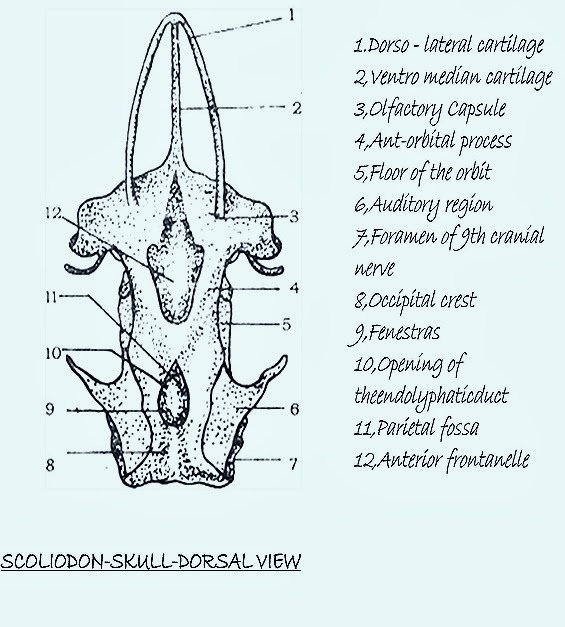
Skull-fish-scoliodon-dorsal     skull-shark-fish-ventralview


skull-frog


skull-frog-ventralview

SKULL OF REPTILE-CALOTES

reptile-skull-lizard

BIRD SKULL

BIRD-SKULL

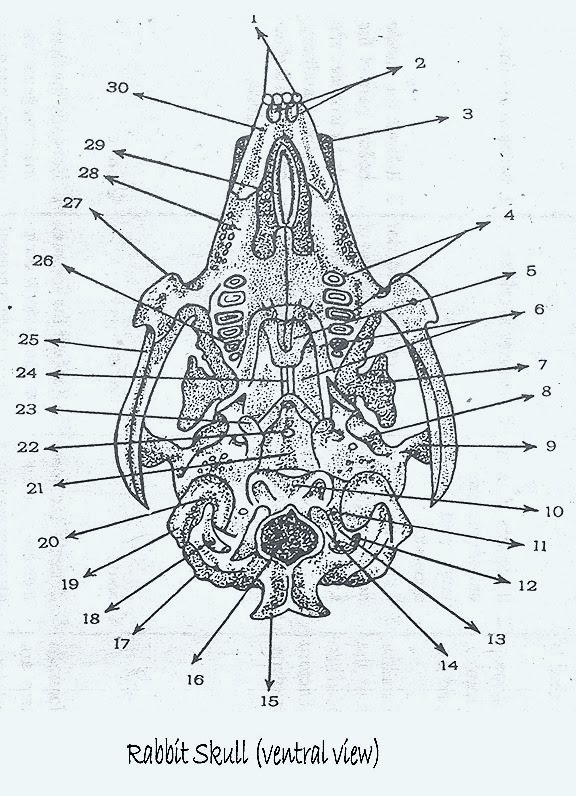
RABBIT-SKULL

skull-rabbit-mammal


skull-rabbit-2

1. First incisors

16.

Foramen magnum

2. Second incisors

17.

Exoccipital

3. Nasal

18.

Paroccipital process

4. Premolars

19.

Aperture of External Auditory meatus

5. Vomer

20.

Tympanic bulla

6. Palatine

21.

Basisphenoid

7. Supra orbital process of frontal

22.

Pitutory foramen

8. AbsphenokJ

23.

Sphenoidal fissure

9. Zygomatic process of squamosal

24.

Presphenoid

10. Basioccipital

2S.

Jugal

11. Eustachian canal

26.

Molars

12. Periotic

27.

Zygomatic Process of Maxilla

13. Foramen Lace rum Posterius

28.

Maxilla

14. Occipital Condyle

29.

Palatine Process of Premaxilla

I5. Supra - occipital

30.

Premaxilla.


BIRD-SKULL-ANATOMY

bird-skull-2bird-skull-fowl

LOWER JAW OF FROG


lower-jaw-frog-skull

LOWER JAW-LIAZARD-(REPTILE)

 skull-lizard-lower-jaw

LOWER JAW-RABBIT

lower-jaw-rabbit


BIRD-MANDIBLE

mandible-bird-fowl

COMPARATIVE ANATOMY OF SHARK SKULL-FROG SKULL-LIZARD SKULL- BIRD SKULL –RABBIT SKULL IN TABEL

SKULL OF Scoliodon (Shark) SKULL OF Rana (Frog) SKULL OF Calotes(garden lizard) SKULL OF Columba (Pigeon) SKULL OF Oryctolagua (Rabbit)
1.  Skull is formed with cartilage tissues. 1.  Skull is formed most­ly with bony tissues (but tadpole skull is cartilaginous) 1. Skull is formed most­ly with bony tissues. 1.   Skull is formed mostly with bony tissue. 1. Skull is formed with ' mostly bony tissue.
         
2.  It consists of crani­um, sense capsules and visceral arches. 2.  It consists of cran­ium, sense capsules, jaws and hyoid ap­paratus. 2. It consists of crani­um, sense capsules, jaws and hyoid apparatus. 2.   Same as in calotes. 2. Same as in calotes.
         
3.  It is the axial portion of the skull. It is more or less a violin box open in front and be­hind with an arched roof and flattened floor. It is divided into occipital, auditory, orbital and ethmoidal regions. 3.  It forms the middle hollow part of the skull. It is divided into auditory, olfactory and occipital regions. 3. It forms the median hollow part of the skull. It is divided into occipital, audi­tory, orbital, olfacto­ry and optic regions. 3.   It forms the posterior median hollow part of the skull. It is divided into occipital, audito­ry, optic orbital and ol­factory regions. 3. It forms the middle hollow part of the skull. It is divided into occipital auditory, optic orbital & olfac­tory regions.
         
4.  Foramen magnum is posteriorly present. 4.  Same. 4. Same 4.   Same 4. Same
         
5. Beneath the foramen magnum a deep concavity is present. On either side of this concavity is a pro­minence - occipital condyle articulates with the first verte­bra, occipital crest is formed. Dicondylic skull. 5.Beneath the foramen magnum there are two occipital con­dyles. On either side Of the foramen mag­num dorso-laterally exoccipital bones are present. Dicondylic skull 5.Beneath the fora­men magnum a sin­gle occipital condyle is present.suupraoccipitai, exo occipitals,& basi occipital bones are also present in the occipital region. Monocondylic skull. 5.Beneath the foramen magnum single occip­ital condyle is present. Supra occipital, Exocci pitals & basioccipital bones are also present. Monocondylic skull. 5.Beneath the fora­men magnum two occipital condyles with paroccipital process are present. Supraoccipital, exo-ccipitai, & basio-ccipital bones are also present. Dico­ndylic skull.
         
6.   Auditory region has a mid dorsal depres­sion - parietal fossa. It contain two pairs of apertures. Anteri­orly smaller open­ings of endolymp­hatic ducts and pos­teriorly larger open­ings of perilymphatic spaces are present. 6.— 6.-- 6.    - 6.    –
         
7.Auditory capsules lie on the poster lat­eral sides of the cranium. Which enclose & protect the ears. Post orbital groove is present on the ven­tral side 7. Auditory capsules enclose the internal ear. Its roof is formed by pro-otic bone, fenestra ovalis, sta­pedial plate and columella auris are present. 7.  Each auditory capsule is formed by small, single vertical prootic bone which is lying outside the supra occipital. Epiotic & opisthotic are not differentiat­ed. 7.    Each auditory capsule is formed largely by the prooticbone. Fenestra ovalis, fenestra rotun da, columella auris, stapes are also present. 7.Each auditory cap­sule in the adult an­imal consists only periotic. Flask - like Tympanic bulla bone is significant.
         
8.  - 8.Dorsally the cranium is formed, by frontoparietals, ven­trally by parasphenoid and laterally by sphen ethmoid bones. 8.  The dorsal part of the cranium is formed by parietals, frontals interparietal foramen, and ven­trally by basisphenoid,parasphenoid bones. 8.  The dorsal part of the cranium is formed by Parietals, frontals a rostum, alisphenoids; ventrally basisphenoid, basitemporal bones. 8.   The cranium is formed dorsally by 'Parietals, frontals, inter parietal, and ventrally by basisphenoids, presphenoid bones along with alis-phenoids and orbit.07 sphenoids. The cra­nial cavity is closed infront by a narrow vertical bone cibriform plate.
         
9.   Each orbit lies on the sides of the middle part of the cranium. It is bordered by dor­sal super orbital ridge,anterior preorbital process, posterior post orbital process and ventraily by infra orbital ridge. The or­bital region has a large oral cavity anterior fontanelle. 9. On either side of the cranium is large gap - orbit which lodges the eye. 9.  9.In the middle of the cranium laterally two orbits are present. Each orbit is bounded by prefrontal supra orbital, lacri­mal, post frontal and jugal bones. The jugal bone forms the ventral border of the orbit. Supratemporal arch is present. 9.  The two orbits are very large cavities present infront of the cranium. Each orbit is bounded dorsally by frontal, antero - dorsally by lac­rimal and posteriorly by the zygomatic process. Orbit is incomplete on the ventral side. The two orbits are separated by inter orbital septum. 9.   These are two orbits are large sockets present on the sides of frontal segment of cranium. The orbit is bounded dorsally by frontal, anteriorly by maxilla and lacrimal, posteriorly by squa­mosal and alisp-henoid and external­ly by the zygomatic arch.
         
10.  The olfactory cap­sules lie at the anteri­or side of the cranium. Each capsule possesses a short sic at ethmopalatine ridge 10.    The olfactory cap­sules are separated, from each other by mesethmoid. Each capsule is formed by a large triangular nasal on the dorsal side and a smaller triradiate vomer on the ventral side vomers possess vomerine teeth. 10. Each olfactory capsule is formed by three bones Nasal, septo maxillary and vomer. 10. Each olfactory capsule is formed by two bones - Nasal and vomer. Nasals fuse with
frontals and form into
super and inferior pro-
cesses.
10.  Each olfactory cap­sule is bounded by dorsally by long na­sal bone and laterally by jaw bones. The two capsules are sep­arated by mesethmoid bone. The lower end of mesethmoid fits into a vomer bone. Vomer is formed by the fusion of a pair of bones.
         
11,Ethmoidal region tapers anteriorly. It consists of a basal slender barventro-median rostral carti­lage and a pair of sim­ilar barsdorso - lateral rostral cartilages aris­en from the roof of ihe olfactory capsules. 11.    Absent. 11. Absent. 11. Absent. 11.  Absent.
         
12.  Scoliodon has seven visceral arches which are cartilagienous. The first arch forms the jaws and it is catted Mandibular arch the second one is the hy-oid arch the remain­ing five arches are called branchial arch­es. 12. Branchial arches are absent.There are upper and lower jaws to support the borders of the mouth. The upper jaw is formed by union of two similar halves. Each half is formed by the Pre-maxilla, maxilla and quadratojugal. The inner set of the jaw has palatine, ptery goid and squamosal bones. The lower consists of two halves and unite an­teriorly by mento-meckelian cartilage. Each half consists of dentary and angio -splenial bones. Just infroni of the articu­lar fact a small coro-nary process is present. Upper jaw alone has teeth. 12. Branchial arches are absent. 12. Branchial arches are absent. 12.   Branchial arches ab­sent.These are upper and lower jaws. Each half of the upper jaw is formed by premax-illa, maxilla jugular, palatine, pterygoid and squamosal.
         
13.  The mandibular arch consists of two halves. Each half of this arch possess an upper paleto-pterygo quadrate cartilage and a lower meckel s cartilage.The pale-topterygo Quadrate gives off anteriorly palatine. The two sides of it from the upper jaw with teeth. The two meckel's cartilages united antero medially by lig­ament form the lower jaw with teeth.   13. These are upper and lower jaws. Each half of the upper jaw consists of an outer set of bones - pre maxilla, maxilla, jugal and quadrate and the inner set in­cludes pterygoid, palatine, transp-alatine, epiptery-goid and squamo­sal. Each half of the lower jaw consists of six bones -dentary, angular, supra angular, ar­ticular, splenial and coronoid. Both the jaws possess teeth. 13. These are upper and lower jaws. Each half of the upper jaw is formed by premaxil-la, maxilla, quadra -tojugal, and jugal bones. The inner ar­cade of the upper jaw forms the roof of bucco pharyngal cav­ity which consists of palatine, pterygoid, and quadrate. Each half of the lower jaw is formed by articu­lar, angular supra an­gular, dentary and splenial. Both the jaws are lacking the teeth. 13.The lower jaw also con­sists of two halves. Each half is formed by a single, large dentary bone. The posterior of the dentary possess con­dylar, coronoid and angular process. Both the jaws pos­sess the codent type of teeth which are having different (Heterodont teeth in mammals) shap­es. Diastema is present in both the jaws because of the absence of canines.
         
14. Hyostylic jaw sus­pension. 14. Auto stylic jaw sus­pension. 14. Auto stylic jaw sus­pension. 14. Autostylic jaw sus­pension. 14. Craniostylic jaw suspension.

also visit-respiration in fish and frog-comparative study