
Showing posts with label CHORDATA. Show all posts

VERTEBRATA-CLASSIFICATION

SUB-PHYLUM VERTEBRATA is further divided into two super-classes.

AGNATHA, AND GNATHOSTOMATA.

Super-Class 1. Agnatha :. (A Without : gnathos=Jaw).

Earlier vertebrates are included in it They do not show jaws, and paired appendages. Nostril is median and single.

Ex: Petromyzon, Myxin.vertebrates-classification

SUPER-CLASS 2 . GNATHOSTOMATA :- (GNATHOS : JAW)

They show true jaws and paired appendages. This group includes the remaining vertebrates from fishes to mammals. ,

- This is divided into 2 important groups Pisces and Tetrapods.

They include 7 Classes. a

Class I. Placodermi :- The Placodermi are the earliest known Gnathostomes They flourished from the early Devonian to Penman periods of the Paleozoic era and became extinct in the beginning of the Mesozoic era.

Ex:CLIMATIUS. . ,.

CLASS 2. CHONDRLCHTHYES :- (Chondro=cartilage : ichthy-fish). These fishes show cartilage skeleton. Five pairs of gill-slits are present They are not covered b operculum. Spiral valve is present in the Intestine. Air bladder is absent Placoid scales are present Many of them are viviparous.

Ex : Scoliodon.

CLASS 3. OSTELCHTHYES. :- (osteo=bone : ichthy fish). These fishes skeleton is bony. 4 pairs of gills are present Gills are protected by operculum. Claspers are not present Air bladder is present except in some teleosts.

These 3 classes are Included in the Group Fishes. Some authors call it as Super class Pisces.

CLASS 4. AMPHIBIA :- (amphi = two : bios = life). They show amphibious life. Exoskeleton is absent Pentadactyl imbs ‘present. Gills are present either in the embryonic condition or throughout the life. In adult condition lungs are present. Heart is three chambered . Portal circulation is well developed. They lay eggs in water

Ex : Necturus, Rana.

CLASS 5. REPTILLA :- (Reptilis creeping). These are first true terrestrial vertebrates. Lungs are respiratory organs. Skin is protected by epidermal scales or by dermal bony plates. Poikilo-thermous or ectothermal animals. Eggs possess a large amount of yolk. During development extra embryonic membranes are formed.

Ex : Urornastix, Crocodile, Calotes.

CLASS 6. AVE :- (aves-birds). These are highly specialized vertebrates adopted to aerial mode of life.

Fore-limbs are modified into wings. Exoskeleton is in the form of feathers. These are all homoeothermic i.e., temperature never varies according to the environment. Hind limbs are provided with 4 toes. Heart is four chambered. Only right aortic arch is present. Teeth are not present in modem birds. They lay big megalecithal egg.

Ex :- Columba.chordate-classification

CLASS :7. MAMMALIA :-

(mammaha = the breast). These are highly specialized vertebrates Body is covered by hairs. In the females mammary glands are present for giving milk to the young Only left aortic arch is seen These are homiothermic animals Sweat glands are present Four chambered heart is seen In many mammals the foetus is in the mothers uterus and is connected by placental stalk.

Ex : Cat, Dog etc.

These 4 classes are included the Group TETRAPODS
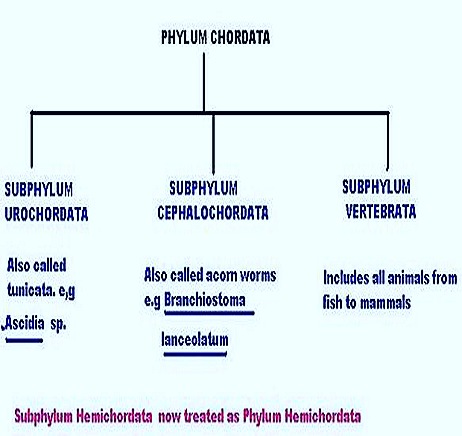
CHORDATE- CLASSIFICATION

PHYLUM CHORDATE-CLASSIFICATION

Phylum Chordate is divided into three Sub-Phyla.

SUB-PHYLUM: 1. UROCHORDATA,

SUB-PHYLUM: 2. CEPHALOCHORDATA,

SUB-PHYLUM: 3. VERTEBRATA.

The first two sub phyla are called lower chordates or PROTOCHORDATES. They are usually called Acrania group. The vertebrata sub-phylum is called CRANIATA group.chordate-classification3

SUB-PHYLUM-i: UROCHORDATA: The urochordate animals belonging to this sub-phylum re called sea-squirts. The adults are marine and mostly fixed. Free living forms are also present. The body is covered by test or tunicin. The notochord and nerve cord are found in the larval stage. in the adult form they are completely lost. Gill-slits may be permanent. They are’ bisexual forms. The larvae are free swimming.

Ex: Olkopleura, A.scidian, Herdmania, etc.

SUB-PHYLUM2 : CEPHALOCHORDATA: cephalochordata are marine organisms. Their body is fish-like with notochord and nerve cord persisting throughout life . They extend the entire length of the body. The eyes, and jaws are absent. The fundamental plan of the chordate body is seen in its most simple form in these animals. Gonads are paired in Amphioxus and unpaired in Asymmetron.

Ex: Amphioxus, Asymmetron.

SUB.PHYLUM 3 :- VERTEBRATA OR CRANIATA : vertebrata are well developed chordates. They show distinct head. Notochord is replaced by the vertebral column completely or partially. The nerve-tubes anterior and enlarged to form a brain. Cranium protects the brain. Visceral clefts called Gills perform respiration. They are not more than seven pairs. Heart is ventral Andes are present They are formed by several segments.

Chordata-classification

ORIGIN OF CHORDATES:

THEORIES ABOUT ORIGIN OF CHORDATES

It is believed that Chordates have originated from invertebrates. It is difficult to determine from which invertebrate group the chordates were developed. Chordate ancestors were soft bodied animals. Hence they were not preserved as Fossils.

Many biology theories were put forward to explain the Origin of Chordates.

1. COELENTERATE THEORY-ORIGIN OF CHORDATES : According to this theory chordates were developed from coelenterates. Radial symmetry coelenteron,cnidoblasts etc, were 1cst and advanced characters were developed to give rise to chordates. This theory infers that chordates might have acquired higher characters independently. It is not correct and hence this theory is not acceptable.chordata-origin

2. ANNELID THEORY-ORIGIN OF CHORDATES : This theory suggests that the chordates have evolved from an annelid stock. The annelids show bilateral symmetry, mesmerism, head, lateral Coelome complete digestive tract, closed circulatory system, hemoglobin, etc., like chordates. The resemblance is enhanced if, an annelid is turned upside down. But the mouth would be dorsal which is unlike that of chordates. Metamerism and appendages of annelids differ in nature from those of the chordates. Bilateral symmetry, head and complete digestive tract occur in other non-chordate phyla also. Coelome is schizocoelic in annelids and enterocoelic in lower chordates. Haemoglobin is dissolved in the plasma in annelids but it is present in the red blood corpuscles in chordates. Annelid nerve cord is double, and, ventral in contrast to single, hollow, dorsal nerve cord of chordates. Some striking differences exist between the annelids and the chordates in their embryology. Hence it is difficult to accept this theory.

3. ECHINODERM -HEMICHORDATE THEORY-ORIGIN OF CHORDATES: This theory infers origin of chordates, hemichordates and echinoderms from a common ancestor. This theory is based on the following evidences.

a) EMBRYOLOGICAL EVIDENCE -ORIGIN OF CHORDATES: Both echinoderms and chordates have enterocoelic coelome, mesoderm and deuterostomous mouth. There is resemblance between the bipinnaria larva of certain echinoderms and the tornaria larva of hemichordates. In echinoderms chordates the central nervous system develops from a dorsal strip of ectoderm.

b) SEROGICAL EVIDENCE-ORIGIN OF CHORDATES: A close similarity exists between the proteins of the body-fluid of chordates and echinoderms. Hence the chordates are more related to echinoderms.

The radial symmetry of adult echinoderms will disprove their relationship with the bilaterally symmetrical chordates. In echinoderms radial symmetry is secondarily developed from a basically bilateral symmetry. Both the primitive and the early echinoderm larvae show bilateral symmetry.

The generalised chordate ancestry is as follows: This was suggested by N.J.Berrill, (1953) in his book “The origin of Vertebrates”. ECHINODERM - AURICULARIA - HEMICHORDATA- TORNARIA -PROTO CHORDATE ASCIDIAN TADPOLE - FREE SWIMMING CHORDATE.

Hyman (1959) and others concluded that all the three groups have a common ancestor, Echinoderms and hemichordates branched off from a common evolutionary line which ended in the chordate group.

VERTEBRATES- CHARACTERS

CHARACTERS OF VERTEBRATES:

Vertebrates show the following characters, besides the chordate characters.Vertebrates

, 1. PRESENCE OF ENDO AND EXO-SKELETON: Vertebrates include internal skeleton which is a notochord or vertebral column. Vertebrates contain exoskeleton, made by scales or dermal plates etc.

2. CEPHALLZATLON - The vertebrates develop a head with brain and sense-organs. The development of the head is called cephelizalion .

3. PRESENCE OF CRANIUM : In all vertebrates cranium is present. The cranium surrounds the brain.

4. PRESENCE OF POST-ANAL TAIL : In all vertebrate animals a post- anal tail is present in the adult or in the embryonic stages.

5. PRESENCE OF PAIRED APPENDAGE : Vertebrates possess two paired appendages. They may be fins or limbs. In fishes fins are present. ln tetra pods two pairs of limbs are present. craniata

6. PRESENCE OF VENTRAL HEART: In all chordates especially vertebrates a muscular heart is ventrally situated.

7. PRESENCE OF CLOSED BLOOD VASCULAR SYSTEM: In chordates the blood flows in the closed vessels of blood vascular system.

8. PRESENCE OF HEPATIC PORTAL SYSTEM: The hepatic portal system is well developed which connects the digestive system with the liver:

The importance of the hepatic portal system is that the excess of carbohydrates are removed and glycogen is stored in liver.

9. PRESENCE OF RED BLOOD CORPUSCLES: Hemoglobin is con- fined to R. B.C. They are helpful to carry respiratory gases.

10. PRESENCE OF PITUITARY BODY : In the vertebrates a pituitary body is present beneath the fore-brain. The pituitary body produces several hormones, which are essential for the normal growth and functioning of the body of vertebrates. . .

1 1. DEVELOPMENT OF ENDOCRINE SYSTEM : Endocrine glands do not possess ducts. Their secretions are directly liberated into the blood. These secretions are called hormones. The function of the hormone is to bring coordination among the functions of all the organ systems of the body.

Thus all the Chordate animals possess these basic chordate characters commonly.

CHORDATES - CHARACTERS


CHORDATES -GENERAL CHARACTERS The animal kingdom is divided into two sub-kingdoms:

1) Chordata and

2) Non-Chordata

CHARACTRS OF CHORDATES:chordate-characters

The Chordate characters appear in the developmental stage will persist in the adult or modified in the adult or disappeared in the adult

They are,

1. PRESENCE OF NOTOCHORD: It is an elastic, longitudinal stiff rod present between the nerve cord and alimentary canal. It is covered by an outer chodal sheath and inner elastic sheath or elastic-internal. Below it vacuolated, non-nucleated cells are present

Notochord is present in the embryos of the vertebrates, but is replaced by vertebral column. In less-developed vertebrates the notochord is present throughout the life.

2. PRESENCE OF PHARYNGEAL GILL SLITS : Gill slits are present on either side of the pharynx. Each gill slit develops in the embryonic stage by evaginations of endoderm in pharynx with a corresponding invagination of ectoderm on the outside of the body. They are useful for respiration. In reptiles, birds and mammals, there are several pairs of gil slits in embryonic life, but they are not functional hence they are closed.

3. PRESENCE OF DORSAL TUBULAR NERVE CORD : The nerve cord in chordates is a hollow tube, situated dorsal to the alimentary canal and the notochord. It develops from the ectoderm. The cavity of nerve cord is called neurocoel.

These chordate characters appear in the developmental stages and they may remain or change or disappear in the adult.

The following characters are seen in all most all chordates.

4. TRLPLOBLASTIC NATURE : They possess three germ layers,

1. Ectoderm, 2. Mesoderm, 3. Endoderm

5. DEVELOPMENT OF TRUE COELOME : In all the chordates a true coelome is present. It develops from mesoderm. The coelome is developed by enterocoelic method.

6. PRESENCE OF BILATERAL SYMMETRY : The body of the chordates show bilateral symmetry. Their body can be divided into two equal halves, through a sagittal plane which passé longitudinally.chordates-bilateral-symmetry

No chordate animal possesses ideal bilateral symmetry, but they are near to such condition.

7. REDUCTION OF METAMERIC SEGMENTATION : Among the chordates, metamerism is seen in the internal structures. The myomeres are seen in lower chordates and segmentation is seen in the embryonic condition of higher vertebrates.

BIOLOGY OF CHORDATES

CHORDATES

The Phylum Chordate includes bilaterally symmetrical, metamerically segmented, triploblastic, enterocoelomate metazoans exhibiting hights complex organization. This phylum is supposed to be one of the most heterogenous and diversified gruop of animal kingdom. The minute sessile cephalodiscus, work-like Balanoglossus, degenerate tunicates, Amphioxus and the true vertebrates have been included in this phylum.

     The vertebrates are fishes, amphibians, reptiles, birds and mammals. All these animals appear to be quite different from each other .However all of them possess certain common characters. These common characters are the presence of Notochord, dorsal nerve cord and gill-slits.

Primary chordate characters:chordate-characeristics2

1 . Presence of notochord or chorda dorsalis:

All Chordates porsess a solid, un segmented and flexible axial rod extending the whole length of the body. It is present mid dorsally and immediately above the alimentary canal and below the dorsal nerve cord. It porsess large vacuolated parenchymatous cells and enclosed in an inner elastic sheath and outer chordal sheath of dense fibrous connective tissue.

The notochord serves s a primitive internal skeleton. It also supports the central nervous system and the segmented muscles. In vertebrates the notochord is completely replaced by the vertebral column.

2. Presence of dorsal nerve cord:

The nervous system of chordates is the form of hollow tube present middorsally above the notochord and below the body wall. It is ectodermal in origin. From the ectoderm a medullary groove is formed which lateral develops neural tolds from its edges and forms the neural tube. Its cavity is known as Neurocoel. In higher chordates the anterior part of the neural tube develops into brain and the remaining part is called spinal cord.

3. Presence of Branchial or Pharyngeal clefts:

- In the life cycle of all chordates the branchial clefts are found universally at some stage. These are formed as perforations in the laterally of pharynx and open to the exterior. Such gill-clefts are developed in every chordate. In certain animals (Amphioxus) these remain throughout life. In Aquatic chordates (fishes) the visceral clefts develop vascular Lamellae gills. These clefts are known as gill-clefts or gill-slits.

In terrestrial chordates these are seen during early development but in the adults modified into lungs. In the lows chordates (hemichordate, Cephalochordate & fishes) visceral clefts help in feeding as well as assist in respiration. In certain terrestrial forms these re modified into endocrine glands.

Origin of Chordates:

There is no reliable evidence in favor of chordate origin. Origin of chordates has no definite conclusions because of lack of fossil evidences.

Recent investigations reveal the relationship among echinoderms, hemichordates and chordates. Certain phosphate is reported in all the three groups which is useful for muscle contraction Echinoderms and Hemichordates are developed from the common ancestor. So the chordates might have developed from the hemichordates.

The phylum chordata is classified into three sub-phyla. (Hemichordate has been given separate phylum status recently).chordate-biology

Simpler forms of chordate animals with notochord completely or incompletely formed are known as protochordates . These sub-phyla cephalochordata, urochordata (formerly Hemichordate) animals may resemble the ancestors of chordates. The vertebral column and skull are not formed in these animals.

In higher chordata animals like vertebrates animals central nervous system with brain & spinal cord, vertebral column and skull are formed along with other respective systems.

also view:CHARACTRS OF CHORDATES