Showing posts with label Animal-Breeding. Show all posts

Cloning

Cloning Procedure

The recent branch in applied genetics is Genetic engineering or Biotechnology or Recombinant DNA technology. The genetic engineering permits cloning in animals breeding.

Clone is a population of cells or individuals which are genetically identical. With the death of an organism, a particular genotype is lost. Cloning is meant for preservation of the genotype of an organism. The cloning is of two types namely

i. Gene Cloning at molecular level

and

ii. Cloning of organisms.

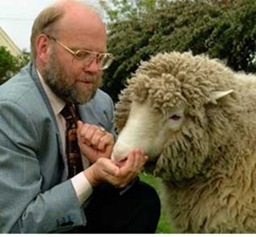
Ian Wilmut of Rocline Institute, Edinburgh has produced a clone of adult lamb named Dolly in the year 1997. The genetic material from udder cells of one sheep was extracted and implanted into another sheep’s egg (that fails to embryonic development) after removing its genetic material. The fused cell developed into an embryo which was implanted into the uterus of another sheep which acted as surrogate mother. The young sheep born through surrogate mother is named as Dolly.dolly-clone-Wilmut

When a useful drug is prepared from a sheep the cloning of such sheep is nothing but establishment of drug factories. Wilmut has cloned Dolly for this purpose.

Dolly was cloned to produce Molly and Polly, two lambs cloned with a human gene for blood clotting factor IX. The milk of Molly and Polly contains Factor IX that can be extracted for use in treatment of human haemophilia.

Attempts are also being made. to create cows and sheep that can produce pure blood for preveriting the infection of HIV and hepatitis virus during blood transfusion. Dolly-cloneing

Simian cloning (Cloning of monkeys) was carried out by Don Wolf (USA) in 1996 from an eight cell embryo. A Japan Scientist, The ruhikoVakayama has made cloning experiments in rats. He has produced number of embryos by using a nucleus and an ovum. A nucleus was extracted from rat’s tissue and injected into another cell without nucleus. Within six hours number of nuclei are produced from a single nucleus. He has created dozens of clones from them. He has also created clones to clones in addition to 50 similar rats of three generations.

Recently in the year 1998 “Perfectural Livestock Research Centre” in TOKYO has created two calves named Kaga and Noto. clones-noto-koga

Human Cloning

Different opinions were expressed on human cloning. About 15 countries have signed an agreement on formulating laws to prevent human cloning. A professor of London university has expressed that cloning of body organs and cells is medically beneficial than cloning of entire body.humon-cloneing

Indian council of Medical Research (ICMR) has also called upon to ban human cloning in India. ICMR has suggested that cloning experiments can be made by embryo splitting but not by nuclear transplantation.

Biotechnology proves that wonderful results can be obtained by careful gene cloning. One can look forward to yield better results instead of bad consequences by this process called cloning.

know more about various animal breeding methods and poultry breeding and cattle breeding

Poultry Breeding

POULTRY BREEDING

Introduction and controlled animal breeding have been helpful in imporving other animal species like chicken, ducks, sheeps and pigs. Aseel, Chittagong and Ghaugs are some of the Desi breeds of fowls. White leg horn, Rhode island red, Black Minorca are the introduced varieties.

India and the neighboring countries are recognised as the original home of the red jungle fowl (Gallus gallus). There is evidence that a Aseel or Malay fowl were carried to Europe through the middle east about 2000 years ago and have given rise to the present day European breeds.

Poultry and poultry products are rich source of animal proteins and other nutrients such as fats, vitamins and minerals . Consumption of eggs would pave the way for overcoming protein malnutrition prevalent among children in India.

The domestic fowl (Gallus domesticus) population of our country can be roughly classified into two types:

i. Indigenous (Desi type)

ii. Exotic (Improved type)

Some of the indigenous breeds like Aseel, karaknath, Ghagus Brahma, Bursa are the best table birds. The Aseel fowls are used in cock-fighting. poultry-brees-cocks

The exotic breeds are classified according to their source of origin, into American class, English class, Asiatic class. Mediterranean class and nature of some Standard classes, common breeds and important fowls rooster-breeds-poultry

The indigenous breeds are crossed with exotic breeds for improving egg production. Heterosis has been utilised for producing better egg layers and broilers with high nutritive value.

also visit cattle breeding

Cattle Breeding

CATTLE BREEDING IN INDIA

        In India farmers depend largely on bullocks for ploughing, irrigation and carting. Hence India needs a good number of efficient bullocks.  Droppings from cattle constitute the most important source of manure for the soil for maintaining its fertility. India is an important supplier of animal skin to the international market. Horns,hoofs and bones are utilized in industries. Bone-meal is used as mineral supplement in cattle and poultry feeds. 

In the villages desirable cattle-breedingbulls are selected on the basis of draughtability and permitted to graze with the cows to bring about random animal breeding. Bulls not selected for breeding are castrated when young and converted to bullocks. They are the main source of animal draught power in India.

About 10-60 per cent cows are artificially inseminated by semen collected from high quality bulls. Artificial insemination ensures good quality progeny and is-also economical as semen from a single bull can inseminate several thousand cows.

An average cow or buffalo produces 8 - 10 calves during its productive life time. Generally only one ovum is fertilised at a time.cattle-breeding2 Selective breeding,progenytesting and improvement take longer time in the livestock than in annual food crops. Majority of Indian cattle have been on marginal inputs and are infertile and poor milk yielders. Research on the cause of infertility led to the use of pregnant mare serum gonadotropin, to increase fertility. Stilbesterol tablets are implanted to induce lactation in sterile cows and immature females

To increase the milk yield, Indian cows are cross-bred with European breeds like Holstein, Brown Swiss, Jersey, Red Dane and others. The Karanswiss and Sunandini are the breeds developed through cross breeding at the National Dairy Research Institute, Karnal, and in Kerala, respectively.


Super ovulation and Embryo Transplantation

It is a kind of animal breeding method in wich A pedigreed bull and a high production cows are chosen to produce super milch cows. Super ovulation is induced by hormone injection. After artificial insemination, 4-10 embryos are collected at a time. Each embryo is then transplanted into a “carrier” cow (surrogate mother). Such embryo transplants can also be carried out in sheep, goats and other livestock. By deep freezing (—1 96°Cy it is posibIe to preserve seven days old foetuses for several years to be used when needed. An embryo can be cut into two, to obtain homo zygotic twins. The most beneficial outcome of embryo transplantation is the selection of high quality bulls for genetic upgrading.


Breeds of cattle

There are over 24 major breeds of cattle and 6 breeds of buffaloes in India. These can either adapt themselves to local conditions or conditions throughout the country. The quality of the cattle, in general, depends on the environmental conditions, especially on rainfall, temperature and humidity Indian cattle are found to do well in dry areas whereas they tend to be small in areas of heavy rainfall such as the coastal and hilly regions of the country. The important breeds of Indian cattle's for different purposes are as follows:

1. Much breeds: Eq - Gir, Deoni, Sahiwal, Red Sindhi etc.

2. Draught breeds: Eg- Malvi, Nageri, Hallikar, Kangayam etc.

3. General utility breeds : Eg- Ongole, Haryana, Kankrej, Tharparkar etc. cattle-breeds

BUFFALLOES

Murrah ,,Bhadaubri ,Jaffrabadi ,S urti, Thehsana ,Nagpuri or Ellichpuri ,Nih Ravi ,cattle-buffelo-breeds

Buffaloes are better than cows because they are more resistant to diseases, give more milk and live longer. Their milk yielding capacity is three times more than cows. Buffalo’s milk is also superior to cow’s milk in fat content and minerals. The number of buffaloes in India is about one third of the cows.

Animal Breeding-Methods

ANIMAL BREEDING-VARIOUS METHODS

The following animal breeding methods are followed for improvement of animals in dairy and poultry namely

1. Inbreeding, 2. Outbreeding and 3. Mutations.

1. Inbreeding

The crossing of closely related animals is called Inbreeding. If this inbreeding animal-breeding-methods is repeated continuously, it is called Upgrading. Inbreeding is used to retain desirable genetic traits in animals. Inbreeding is required in order to retain as many traits as possible by keeping the combination of genes intact.
However, the inbreeding may result in homozygous recessive genes coming together to express some harmful phenotypic traits. Many breeding scientists have observed that hybrid vigour and fertility were lost due to repeated inbreeding. Such recessive and harmful genes are removed by some special techniques without sacrificing the major quality of the animal. If the race is relatively free of such harmful recessive genes, the process of inbreeding is a safe method for improvement of animals.

2. Outbreeding

    The crossing of distantly related animals is called Outbreeding. One of the problems the animal breeder faces in outbreeding is introduction of new genes into population. In this method it is possible to breed a desirable type of animal with a less desirable type and then to increase the degree of desirable traits. New and high yielding genes can be introduced into the population through outbreeding. In many cases these genes may come from a variety of stock.
Out breeding in animals is useful for different purposes viz., A

i. To produce some valuable traits ii. To create new breeds iii. To produce a hybrid of superior vigour and value.

i. To produce some valuable traits:
Beef cattle may be crossed with dairy cattle to produce calves for superior veal (flesh) production.

ii. To create new breeds:
A new breed is produced with desired characters from the two original breeds. This process of producing new breeds takes time. The present day breeds of animals have been developed through hybridisation.

iii. To produce a hybrid of superior Vigour and VaIue

A Mule is produced by crossing Equus equus (mare or female horse) and Equus homonius (jack or male ass). Mules are superior to horses in strength, endurance, resistance to disease and ability to work under unfavorable conditions. When a female mule is crossed with a jack, a colt is produced.

3. Mutations 

The new traits into populations can also be induced through mutations. Since most of the mutations are harmful and the process of induction of animal-breeding-mutation-cattle mutations is quite expensive, this method of improvement of animals is impractical. It has been reported that a sheep in New England mutated in the direction of having shorter legs (a desirable quality) and formed the basis for racial improvement of sheep.
Representative examples of improvements in animals by mutations include poultry that is resistant to white diarrhoea, increased egg production in fowls, increased fat content in milk and better meat yielding in Turkeys etc.

Animal Breeding-Introduction

INTRODUCTION to ANIMAL BREEDING


From the very early days human beings depend on animals and animal animal-breeding products for food and other requirements. In dairy and poultry farms high yielding animals are reared. These high yielding animals are produced by hybridisation experiments. Previously the animals were developed basing on unscientific methods. Before the discovery of principles of heredity human beings have selected the animals with required characters and learned to develop the plants having the selected characters. This phenomenon is called Artificial selection. However, an increased knowledge of biology, especially genetics, has helped in improving the quality of animals and animal products as per the human requirements.

  ANIMAL BREEDING-PRINCIPLES
The animal breeder faces many complex problems during hybridisation experiments because many traits of animals are dependent on the animal-breeding-1 interaction of multiple genes. When the attempts are made only to increase the size of eggs in fowls,it was observed that the progeny produced yielded few number of eggs or even they die sometimes. That is if only one character is taken for improvement of the animals, the other characters will degenerate or result in harmful effects. Hence at the time of selection all the desirable characters are to be taken into consideration. The techniques for the improvement of animals involve principles of selection based on quantitative variations. It is not possible for all of the desirable traits to be obtained in one individual. The successful product must contain maximum number of desirable traits and a minimum number of undesirable traits.

1. The body form

It is an important factor in selecting racially improved variety of animals. A certain body form in cattle and broilers will be having high market value. They yield delicious mutton if they are having well built body form. horse-breeding

2. Productivity
This is of great significance to the breeder. Some times it has first priority over other traits. For example the number of eggs, quantity of milk, or wool per animal is an important criterion in any programme of improvement of animals.

3. Quality of the product
In addition to the quantity, the quality of the productivity is also to be taken into consideration during breeding experiments. The cattle which yield low quantity of milk but having high percentage of fat content are more prominent than those which yield high quantity of milk but with low percentage of fat content. Similarly he quality of wool in a sheep is more important than the quantity of wool.

4. Resistance to diseases
The ability of the animal to resist diseases, to withstand adverse environmental conditions are also important in the animals produced by hybridisation experiments.

5. Early maturity
It is another trait that the animal breeders look into for improvement of animals. The earlier, the animals mature to the productive age, lesser is the cost of maintaining them. If a hen matures early and begins egg production, it is more valuable than that which matures later.

6. Economy in the use of food
If the amount of food required to produce a certain quantity and quality of animal product is comparatively higher, the commercial value of such an animal is said to be very low.
In milk yielding cattle and egg yielding fowls if most of their food material is converted into productivity, such cattle and fowls are considered as more valuable. The above-mentioned are only few of the desirable qualities that the animal breeders select for improvement of animals.

continue reading on various Animal breeding methods and cattle breeding and poultry breeding