Showing posts with label AMPHIBIA. Show all posts

NEOTENY-PAEDOGENSIS

 PAEDOGENSIS or NEOTENY in AMPHIBIANS

Neoteny is defined as the failure or delay of larva to metamorphose while becoming sexually mature. It is character of some amphibians.

The best example is axolotl larva of Amblystoma. It is aquatic. It has gills. It neoteny-Amblystoma2 develops gonads. It lays eggs and attains large size. Amblystoma on the other hand, is terrestrial and without gills. It was considered the axtolotl as a separate genera in the beginning, with the administration of thyroxine, axtlotl lost its gills and develops lungs. It metamorphosed into the adult. Metamorphosis of axolotl can be induced by reducing the water level.

Proteus. and Necturus are permanently neotenous forms. They retained the larval features and reproduce sexually like a mature animal.

Kollman has distinguished two types of neoteny:

1. Partial neoteny: Tadpoles of Hyla arborea, Rana escülenta during winter will show simple retardation of metamorphosis beyond the normal period.

2. Total neoteny: It will retain its gills and becomes sexually mature.

Ex Amblystoma.

Formerly full neotenic forms with external gills were considered as most primitive amphibians. But now it is believed that it is the result of secondary adaptive modifications in their larval stage.

previous topic is classification of Amphibia

AMPHIBIA-CLASSIFICATION

Classification of Amphibia


Based on characters of amphibians the present day (extant) amphibians are classified Into 3 orders. amphibia-classification

Order I . Anura - (Frogs and Toads).

Order 2. Urodela - (Salamanders).

Order 3 Apoda - (Limbless amphibians)


Order 1. Anura

This order Anura includes frogs and toads.

1) They can live in water and on land.

2) The fore limbs are small, the hind limbs are long.

3) In the adult stage tail is absent

4) They show a pair of eyes. tympanic membranes.

5) Their Life history includes a larval stage called tad-pole larva.

eg:1. Alytes . (Mid wife toad). 

2. Cacopus (Burrowing frog).

3. Xenopus (Clawed Toad),

4. Bufo.

Alytes-amphibia-prental-care  bufo

xenopus-Anura

Order 2. Urodela

This order includes Salamandars and newts. These urodelans are more in North America. Hence North America is called Head Quarters of Urodela

1) The body is divisible into head, trunk and tail. Only In these amphibians tail is present. Hence these are called Urodela.

2) The fore limbs and hind limbs are equal.

3) The body’s not covered by scales.

4) In some adults the gills are presents

5) Some forms show neoteny and paedogenesis. In North India only one species is available. Tilototriton venvcosa. In South India urodelan animals are absent.

1.Necturus

2. Proteus(Mud puppy).(Blind salamander)

3. Molge (Newt).

4. Amblystoma


Amblystoma2

Necturus

Order 3. Apoda:

1) These animals are limbless. Hence they me called Apoda.

2) The body is long and snake like. Hence it Is called gymnophiona. The body is divisible into head and hunk. Tail is absent

3) On the head two eyes are present. They covered by skin and scales. Hence they are blind (Cecaelians).

4) Lungs are asymetrical.

5) The skin shows minute cycloid scales. in the male apoda animals copulatory organs present.

6) Fertilization is internal.

1. lchthyophis (Limbless amphibian).

2. Gegenophis (Limbless amphibian).

3. Ureotyphlus.

lchthyophis

 Gegenophis

 Ureotyphlus1

All these 3 genera are available in Malabar Coast of South India.

AMPHIBIA-GENERAL CHARACTERS


Amphibians are cold blooded vertebrates. In the Devonian period ofAMPHIBIA1 palaeozoic era they were originated from fishes, in the carboniferous period, they increased their number, hence that period is called ‘Age of amphibians’

According to Romer Dipnoi fishes are the “uncles of Amphibians” According to Newman “Dipnoi and amphibians had same grand father.”


General characters of Amphibians

1) Amphibians are cold blooded vertebrates which can hue on land and in water.

2) Amphibians show four limbs with which they can swim in water and jump or walk on the land, (But In apoda limbs are absent.)

3) In Amphibians  animals exoskeleton is absent. But in apoda animals small cycloid scales are present.

4) In Amphibians the adult animals lungs are present. Gills are absent. But In some urodelans the gills are present. amphibians

5)Amphibians Skin is a respiratory organ.

6) The Amphibians skull is dicondylic.

7) Amphibians Ribs are absent.

8)In Amphibians The body divisible into head and trunk Tail is present in, urodela animals.

9)Amphibians  Digestive system is well developed. A well developed liver Is present

10) External ear is absent. Middle and inner ears are present, the middle ear columella auris Is present.

11)Amphibians Heart is 3 chambered with 2 auricles and 1 ventricle The blood contains R.B.C. They are nucleated. They contain hemoglobin.

12) Blood vascular system contain hepatic and renal portal systems.

13) Amphibians Kidneys are mesonephric. Urinary bladder is present. It stores urine.

14) Central nervous system is well developed. The brain occupies completely the cranial cavity. The brain is divided into fore, mid and hind brains. Brain continuous as spinal cord.

15)10 pairs of cranial nerves will arise.

16) Sexes are separate.

17) Male and female can be indentified - Sexual dimorphism.

18) In Amphibians the life history a larva stage may be present.

19) Amphibian Eggs are telolecithal, Cleavage is holoblastic unequal.

AMPHIBIANS-INTRODUCTION

 
Amphibians are the earliest tetrapods. They were descended from fish like ancestors. They were 4eveloped in the Devonian period. They flourished during carboniferous period. It is called “Age of Amphibians”.AMPHIBIANS
Amphibians can lead their life on land and in water. They are cold blooded vertebrates. They show four pent dactyl limbs. They are supported by pectoral and pelvic girdles.
Their skin is soft. It is glandular. They do not how exoskeleton. They perform respiration by lungs and skin. In some amphibians gills are also seen. They show three chambered head. Their R.B.C. are nucleated. Sexes are separate.
In the present day world nearly 15000 species are living. They belong to only three order
1) Anura 2) Urodela 3) Apoda


PARENTAL CARE -AMPHIBIANS


PARENTAL CARE IN THE MEMBERS OF CLASS AMPHIBIA

Amphibian include anurans, urodelans and apodans. In all these groups of amphibians we come across with a great deal of parental care. Amphibians show several mechanisms to protect their eggs and developing young ones because of the they lay few eggs.amphibia-parenteal-care

Parents protect the eggs and early developmental stages in two ways.

1) They construct nests

2) Direct Nursing.


The female Icthyophis glulinosa will dig a hole in the moist soil near a pond. It will deposit eggs in it. Around this egg mass the mother will coil and. protect the egg mass from the enemies.Icthyophis-glulinosa-parentalcare-amphibia

2. PARENTAL CARE IN E ORGANISMS CF URODELA:

In some urodela amphibians the eggs are very small. They hatch end directly develop into larvae. In those organisms parental care is not required.

a) Protection by Nests :- Salamandrella keyserlingi will construct a gelatinous bag like structure. It is attached to an aquatic plant below the water. In this bag eggs are stored. Thus they are protected by the Nest.salamandrella-keyserlingi-eggs

ii) Autodax will lay eggs in a dry hole on the soil or in a hole on a free. The parents also live in the hole and protect the egg and the larvae developed from them.Autodax-eggs1

b) Direct Nursing by Parents

I) Amphiuma, (Congoeel) The mother will coil around the eggs and protect them.Amphiuma-congoeel-eggs

ii) Desmognathus fuscus, (the dusky Salamander) The mother will carry the eggs. They are attached around its neck.Desmognathus-eggs

L Salamandra salandra, (the European fire salamander) :- The mother will retain few eggs in its body. It liberates the larvae into water. They complete their development in the water.

iv) Salamandra atra, (the European alphine salamander) : The mother keeps the eggs in its uterus. It liberates only the young ones which are completed their metamorphosis.

3. PARENTAL CARE IN ANURA AMPHIBIANS:

In Mura amphibians the parental care is reached its peak. Many organisms will exhibit parental care.

a) Protection by Nests:

Many frogs and toads build nests in which the eggs are laid and developed. This is a primitive method of parental care. In these organisms the larva comes out in a very early embryonic stage which requires some kind of protection in the very early stages of development, hence the parent will build nests.

I) Hyla Faber:- It is Brazilian free frog. The female will construct the nest in the shallow waters of a pond. The female will dig a hole of 8 to 10cm depth. The mud which comes out of it is used by the female Hyla to construct a wall around the hole. This wall is raisd’above the level of water. Female Hyla will make the inner surface of this Nursery smooth and even the female will lay eggs in this nursery. The eggs and larval forms are protected inside this structure.

ii) Rhacophorus malabaricus It is called chunam frog. It lays eggs on the branches or leaves of a tree which will be hanging over a pond. These larvae after hatching from eggs will fall into the pond water and undergo metamorphosis. parental-care-frog

lii Rhacophorus schlegeli It is called Japan free frog. Both male and female frog will make a burrow in the moist soil near a pond edge .This hole is filled with foam by female. Then female lays eggs in this foam. The male and female animals will make an exit tunnel into the pond from the hole. The larvae developed from eggs will be carried by the liquid formed from the foam into the pond through these exit tunnels.

lv) Hyla resinfectris It is a free frog. It will make use of holes in the frees. It will line the hole of free trunk with beewax brought from bee comb. Female animal lays eggs in this hole when filled with rain water.

v) Leptodactylus mystacinus It digs a. hale in the moist mud near a pond. This hole is filled with foam which is secrete4 by the oviducts of the female. Female lays eggs in it. These eggs hatch into larvae then the pond will get good amount of water from rain. Then these holes are also sunounded by the pond water, Then the larvae will enter the pond and grow.

vi) Hyla nebulosa It lays its eggs in a nest. This nest is made by dry leaves. The eggs hatch and develop into small adults. Larval form is absent.rhinoderma_darwinii-parentalcare

vii) Hylodes : It is an American frog. It deposits its eggs in moist places or under the stones. The eggs hatch and give tiny adults in perfect condition.

2) Direct Nursing by Parents:

This method is more advanced than protecting the eggs and larvae by constructing nests.

1) Alytes . It Is called Mid-wife-toad When the eggs are laid by the female frog winds the strings of eggs round his back and thighs. This male frog lives in a shallow pit of the moist soil, It will came out of the pit now and then for feeding and to make the eggs moist. When the eggs are ready to hatch the male frog moves to a near by pond and the larvae are released.Alytes


2. Gastrotheca It is called New World brooding (or) Marsupial frog. It has a special pouch in its skin. It opens out through an opening near the cloaca. Fertilized eggs are transferred into this pouch. The eggs are stored in this pouch where they ‘undergo development and tadpoles are liberated out.amphibia-prental-care-1

3, Pipa americana It is called surinam toad. During breeding season the skin of the back of the female becomes soft and spongy. During copulation the oviducts will come out of the female- Because of the movements of male the eggs are forced out of the oviduct. Each egg sinks into a small pocket of the skin. It gets coveted by an operculum. In the soft maternal tissue the young one can develop safely. The developing embryo has a tail and yolk sac. It has no gills. The tail may work like placental connection to draw nutrition from the mother. Nearly after 80 days small individuals may come out.Pipa-americana

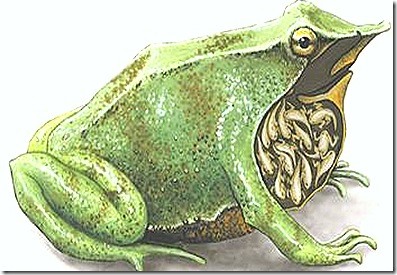
4. Rhinoderma darwini It is called little South American frog. The fertilized eggs are transferred into its vocal sacs the development takes place. Then the completely developed young individual will jump out from the mouth of the male frog.amphibia-prental-care
Thus in Amphibians a good  amount of parental care is seen.
