Showing posts with label FISHES. Show all posts

FISHES-ECONOMIC IMPORTANCE


Fishes are very important to man economically.

1. As food,

2. They give by-products.

3. To control diseases.

Fishes as Food: - Fish is good food to man. The flesh of flesh is rich in proteins and fat. Dry fish also contains A and D vitamins. It contains minerals. Much of the flesh can be digested by man. Food fishes are both marine and fresh water.

Ex: - Labeo, Catla, Trygon, etc

fish-food-1 fish-food

fish-flesh-food

FISH-By-product:

Fish oil: - From the liver of the many fishes oil is extracted.

A. Cod liver oil: - It is extracted from the cod fishes.Cod-liver-oil

B. Shark liver oil: - It is extracted from the liver of the shark. These oils contain A and D vitamins.Shark-liver-oil

The Extracted oil from Bombay duck is used in Paints.

Fish meal: - Many fishes are dressed and cooked. Then they are dried. Fishes are made into fine powder. This is called fish meal. It is used by weak and convalsent people.Fish-meal Fish-meal-bags

Shagreen :- It is dried skin of sharks. It is used as an Abrasive.Shagreen1

Isinglass :- It is a pure gelatin substance. it is obtained from air bladder of the fishes. it is used to clarify wines.Isinglass

Fertilizers: - The ‘fish waste’ materials have more calcium, protein, phosphorous and other substances. These materials are grined into powder. It is used as fertilizer to Grape gardens, Coffee and Tea plants.

Controlling Diseases:-Some of the fishes like Gambusia barbus will eat the larval forms of mosquitoes. Thus they prevent the spread of malaria disease. Gambusia-mosquitoes-eat-fish

Neuromast system in Fishes

Neuromast (organs) system (or lateral tins sense organs)

On the lateral sides of think and tall lateral line canals are present. They are present deeply In the dermis. In the head region there are connected by transverse canals. In the head region cephalic canals are present Neuromast (organs) system

Neuromast

1. Infra orbital

2. Supra orbital,

3. Hyo mandibular.

4. Mandibular. Neuromast-orgnan

From-these lateral line and cephalic canals small tubes win arise and open on the skin. These canals are lined by epithelium. They contain gland cells. Recreceptors are present. The Chemoreceptor is (neuromast) group of spindle shaped neuro sensory. They are connected will

nerves. The nerves connected with VII Cranial nerve.

The lateral line system detects waves and currents in water.

OLFACTORY LOBES IN SHARKS

Sharks-Olfactory lobes

In Scoliodon the olfactory lobes are olfactory organs or nasal sacs.

They are present in the olfactory sacs of cranium. They develop from the ectoderm. They open out through the exterior by external nostrils. Each nostril is divided into two parts. In current siphon and excurrent siphon.Sharks-Olfactory lobes  Olfactory-lobes-Sharks

The olfactory lobe is lined by olfactory epithelial This epithelium Is called schneiderian membrane. it shows spindle like olfactory cells, sup porting cells and gland cells. The olfactory cells connected with a nerve fiber. All of them are united and olfactory nerve is formed. It will meet the olfactory lobe of the brain. Schneiderian membrane is folded. Hence the olfactory surface is increased.

The folds of two series are set a part by medina raphae. The olfactory cells are sensitive to the chemicals in the water.

previous topic is claspers in sharks

CLASPERS IN SHARKS:

 
In male shark claspers are present. The claspers are rod like copulatory organs present on the inner borders of the pelvic fins. They are supported by carfilages. Each clasper has a groove on its dorsal side. The groove is opened at both the ends. Its anterior opening is called the apopyle and the posterior opening the hypopyle communicates with the cloaca. It receives the sperms from the cloaca. The hypopyle is as an exit for the sperms into the cloaca of the femaleCLASPERS-SHARKS1


claspers-shark
CLASPERS- SHARKS2

INTERNAL EAR OF SHARK (OR) MEMBRANOUS LABRYTH

Membranous labryth in Sharks

It lies in the auditory capsule of the skull. It is useful for maintenance of equilibrium. In the fish external and middle ears are absent. Internal eats covered by cartilaginous labyrinth. A space is present between membranous and labyrinth is filled with perilymph.

The membranous labyrinth shows laterally compressed sac. It is divided into utriculus and sacculus. At the end of the sacculus lagena is present.

The internal ear shows 3 semi circular canals.

1. Anterior vertical semicircular canal.

2. Posterior vertical semicircular canal.

3. Horizontal semicircular canal.

These semicircular canals end with ampullae. Membranous-labryth

From the dorsal side of the internal ear duct arises. This is called saccus endolymphaticus. It opens out on the skin.

In the ampullae sensory patches are present, they will be acoustic in nature, in the utriculus and sacculus otholiths are present. They are mainly useful for maintenance of balance. Thus the internal ear is useful for caring and maintenance of balance.

also know more about OLFACTORY LOBES IN SHARKS

AMPULIAE OF LORENZINI IN FISHES

 
On the upper and lower surfaces of the head a number of tin- branched structures are present. They are called ampullae of lorenzini.
Each ampulla contains two parts.
1. Expanded ampullary sac and
2. A long narrow ampullary canal.GREAT WHITE SHARK, Carcharodon carcharias, MEXICO.


AMPULIAE- LORENZINI


The ampullary sac contains 8 to 9 chambers. They are separated by septal walls. They are arranged around a central axis. These chambers contain sensory papillae. These sensory papillae are connected with nerve fibers.
The ampullary canal is long and narrow. It is filled with mucus. It opens out through a pore.
These sense organs will work as thermo receptors. They detect the temperature changes of the water. They also detect the changes in the pressure.


PISCES –(FISHES) CLASSIFICATON:

PISCES-CLASSIFICATION

The super class Gnathostomata includes craniates, in which one pair of the visceral arches is modified into this jaws. They how internal ear with three semi-circular canals and provided with paired 4, apdages (fins or limbs). Sexes are separate. The super class is divided into, two groups.

1) Pisces and 2) Tetrapoda.

Pisces Include three classes.

.1) Placodemi,

.2) Elasmobronchi (Chondrichthyes),

3) Osteichthyes.

Muller, Goodrich. Berg, Romer etc, classified the Pisces. There is no agreement among many authors with respect to the classification of fishes.

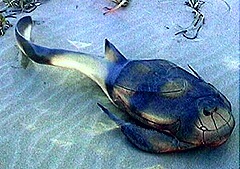
Class 1 Placodermi (Aphstohyoids)

1) It includes extinct fishes.

2) They are all armored fishes. Their exoskeleton Is in the form of bony plates or shields.

3) Their endoskeleton is bony:

4) The hyoidean gill-slits are complete. It is not reduced.

5) The autodiastylic jaw suspension is seen in these fishes.

6) Heterocercal caudal fin is seen.

7) Hyoid arch will not support the jaws.

8) Primitive jaws are seen.

9) They survived up to Permian period of Paleozoic era.

Ex Climatius, Bothriolepis.
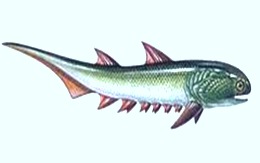
Climatius

Bothriolepis


Class 2. Chondrlchthys or Elasmobranchi

1) These fishes are exclusively marine.

2) The exoskeleton in the form of placoid scales.

3) Their endoskeleton is cartilagenous and are called Cartilage

4) Jaw suspension is amphistylic or hyostylic.

5) 5-7 pairs of gills are present.

6) External gill openings are separate. They are not covered by operculum.

7) Heterocercal caudalfin is seen.

8) Males show claspers for copulation.

9) Air-bladder is absent in these fishes.

The Class Elasmobranchi is divided into two sub-classes.

1. Sub-class Selachi :-

In these fishes the pectoral fin has cartilagenous rods. Fins are well developed. The caudal fin is hetetocercal. This subclass has four orders in which only two are living.

Order 1. Proto selachl

1) Jaws show many pointed teeth.

2) Nasal openings are paired.

3) Hyostylic or Axnphistylic jaw suspension.

It is represented by few living species.

Ex :Heteroloatas

Order 2. Euselachi

1) Skin contains placoid scales.

2) These fishes are exclusively marine.

3) 5 pairs of gill slits. They open separately. It is divided into two

1. Sub-order . Pleurotremata:

1) Gill slits on the lateral sides of the body.

2) Pectoral fins are distinct.

3) It includes sharks and dog fishes.

Ex :- Scoliodon, Sphyrna (Hammer headed shark), Stegostoma (Tiger shark).
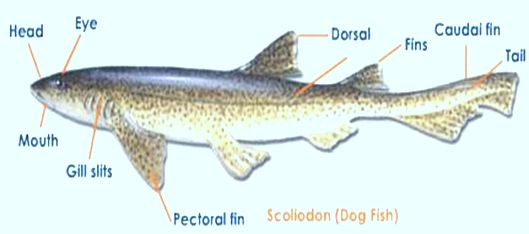
Scoliodon-shark

Sphyrna-Hammer-headed-shark

stegostoma-tiger-shark1

2. Sub-order Hypotermata:

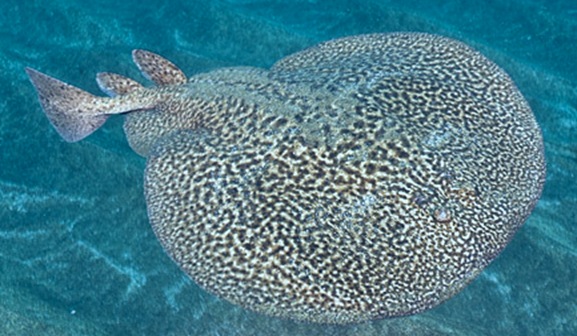
1) It includes skates And Rays.

2) The body is flattened dorso-ventrally.

3) Pectoral fins are enormously expanded anterio posteriorly and gill openings are ventral and five in number.

4) Dorsal fins, if present are seen on the tail.

Lx :- Pristis (Saw fish), Rhinobatus (Guitar fish), Torpedo (Electric ray), Raja (Skates), Trygon (sling rays), Myliobatis (Eagle rays)

Pristis_Saw-fish1

Marbled Torpedo Ray 015

Sub-Class 2; Bradyodonti

It includes fossil and modern chimaeras.

1. Mouth is small and bounded by lips.

2. Holostylic jaw suspension is seen.

3. Gill opening are enclosed in boneless operculum.

4. Male possesses a frontal clasper on the head.

It is divided into 2 orders.

Order 1. Eubradyodonti

‘It includes Helodus’.

order2. Holocephali

It includes chimaera. These are called devil fishes. Chimaera

also called king of Hernngs. Chimara
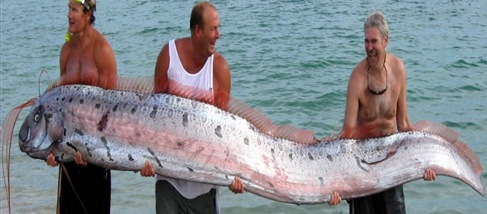
Chimara-king-of-herrings

Class 3. Osteichthyses a Telostomi

1. These fishes are marine, fresh water and bracldsh water niem hers.

2. Cycloid, ctenoid or ganoid scales will form the exoskeleton.

3. Endoskeleton bony.

4. Jaws suspension is autostylic

5. Operculum is present.

6. Claspers are absent

7. Usually air bladder is present

This class is divided Into two sub-classes.

Sub-Class I. Crossopterygii,

Sub-Class 11. Actinopterygii,

Sub-Class-I: Crossoptenygii

In this sub-class bony fishes are Included which show lobed and massive fins. The sub-class includes two orders,

Order - 1 Rhipidistia

This order includes extinct fishes. But in 1938 one coelacanth fish was caught. This was identified as, Rhipidistian fish by Miss. Latimer. The fish is called Latimeria. It is the oldest living fossil. coelacanth-Latimer

coelocanth

Ortler -2. Dipnoi

This order Includes living fishes. In the present day only 3 genera are living. They show discontinuous distribution.

Ex: 1. Neoceratodus (Australian lung fish),

2). Protopterus (African lung fish),

3. Lepldosiren (South American lung fish). Dipnoi-discontinuous-distribution


Sub-class II Actinopterigii

These fishes will live in fresh water or marine water. They not show internal nostrils. This subclass is divided into three super orders.

Super order I: Chondrostei

This super order includes 3 orders, only fishes of one order or surving

Order polypterifonnes :- The fishes wtth ganoid scales Caudal fin is symmetrical. Dorsal fin has many peculiar fin-lets.

Ex:Polypterus.

Super order II: Holostel:

This include 2 orders.

Order 1. Amiiformes.

Caudal fin is heterocercal. Ex Antia (Bowin).

Order 2. Lepldoeteiformes:

Nasal opening at the end of the much elongate snout. Caudal fin is abbreviate heterocercal.

Ex: Lepidpsteus (Gar pike).

Super order III. Telosteti : This is a very important super order. It includes nearly 25,000 species. They are divided into many orders.

Order I. Clupelfonnee : Caudal fin is homocercàl.

Ex: 1. Hilsa hisha (Herrings).2. Salmon. 

salmon-fish

hilsa-Herrings1  

Order 2. Cypriniformes: Weberian ossicles connecting the ear with air bladder is present. Mr-bladder is connected with duct to the alimentary canaL

Ex : - Carps. (Labeo, Cinhina, Barbus).

Order 3. Anguilllformes. : Body eel like, air-bladder, If present connected with intestine by a duct.

Ex:Anguilla.

Order 4. Beloniformes :Physoclistic fishes in which fins are without spines.

Ex : Exocoetus, (flying fish)., Cypsilurus

Order-5. Syngnathlformes: Physoclistic fishes In which the first dorsal fin, If present, Is spinous.

Ex Hippocampus (Sea horse). Syngnathus (Pipe-fish)

Order 6: Syinbranehiformes: Eel like body, air-bladder is absent spines absent In fins.

Ex Asnphinuous.

Order 7. Psrciformes: Physoclistic fishes fins usually with spines. Usually two dorsal fins.

Eg: Fierasfer, Anabas (Climbing perch).

Order 8. Pleuronectiformes. Both eyes are situated on one side skull is asymmetilcal. Fins usually without spine. Adults without air bladder.

Ex :Cynogiossus

Order 9. Echenelformes The spinous dorsal fin is t into an adhesive disc placed on the head. Air bladder is absent.

Ex: Echenis (Sucker fish).

Order 10. Ophiocephaliformes: Physoclisfic fishes in which are Without spine, scales are cycloid, air bladder is very long.

Ex Channa or opiocephalus.

Order 11. Tefradontiformes : Gill openings restricted air bladder is present or absent.

Ex: Tetrodon, Diodon (Porcupine fish).

Order 12. Gadiformes Physoclistic fishes in which fins are without spines, scales cycloid. -

Ex Gadus (cod).Gadus-cod-fish

FISHES –PIECES GENERAL CHARACTERS


Fishes are first evolved in silurian period of palaeozoic era. They increased their number in Devonian period. Devonian Period Is Called Age of Fishes. Devonian-Period

Fishes are first jawed vertebrates. They live in water. They are cold blooded vertebrates.

Fishes-Characters:

1. Fishes are aquatic; cold blooded vertebrates.

2. Their body is divisible into head, trunk and tail. Neck is absent.

3. It has a spindle shaped body. It is helpful in swimming.

4. The body is covered by scales. They are placoid scales, cycloid scales, ctenoid scales, ganoid scales etc.placoid-scales

ctenoid-scales

ganoid-scales

5. Respiration is by gills. Gills are the extensions of the pharynx. In the elasmobranches fishes, the gills will open separate. In bony fishes the gill slits are covered by operculum.gills-fish1

6. On the head a pair of nostrils are present internal nostril are absent. In Dipnoi Internal nostrils are present

7. On the head a pair of eyes is present.

8. On the lateral sides of the body LATERAL LINE SENSE organs are present .They detect the pressure changes of water.

9. The body shows paired and unpaired fins. Pelvic and pectoral fins are paired. Dorsal and ventral fins are unpaired. They maintain balance in water. They are useful for locomotion. The InfoVisual.info site uses images to explain objects.

10. The digestive system is well developed. In the intestine of shark scroll valve Is present. The nervous system contains brain and spinal cord. Brain is small & it will not occupy the entire cranial cavity.

11. 10 pairs of cranial nerves are present.

12. Kidneys are mesonephrlc.

13. Urinary bladder is absent

14. The skeleton of some fishes is made by cartilage. They are called cartilage fishes. In some fishes the skeleton is made by bone. They are called bony fishes.

15. In some fresh water fishes accessory respiratory organs are present. They will take up aerial respiration.

16. Sexes are separate. In male sharks claspers are present.

17 Many fishes are oviparous. Some fishes are viviparous.

18. In the development of fishes amnion is not developed. Hence these animals are called anamniotes